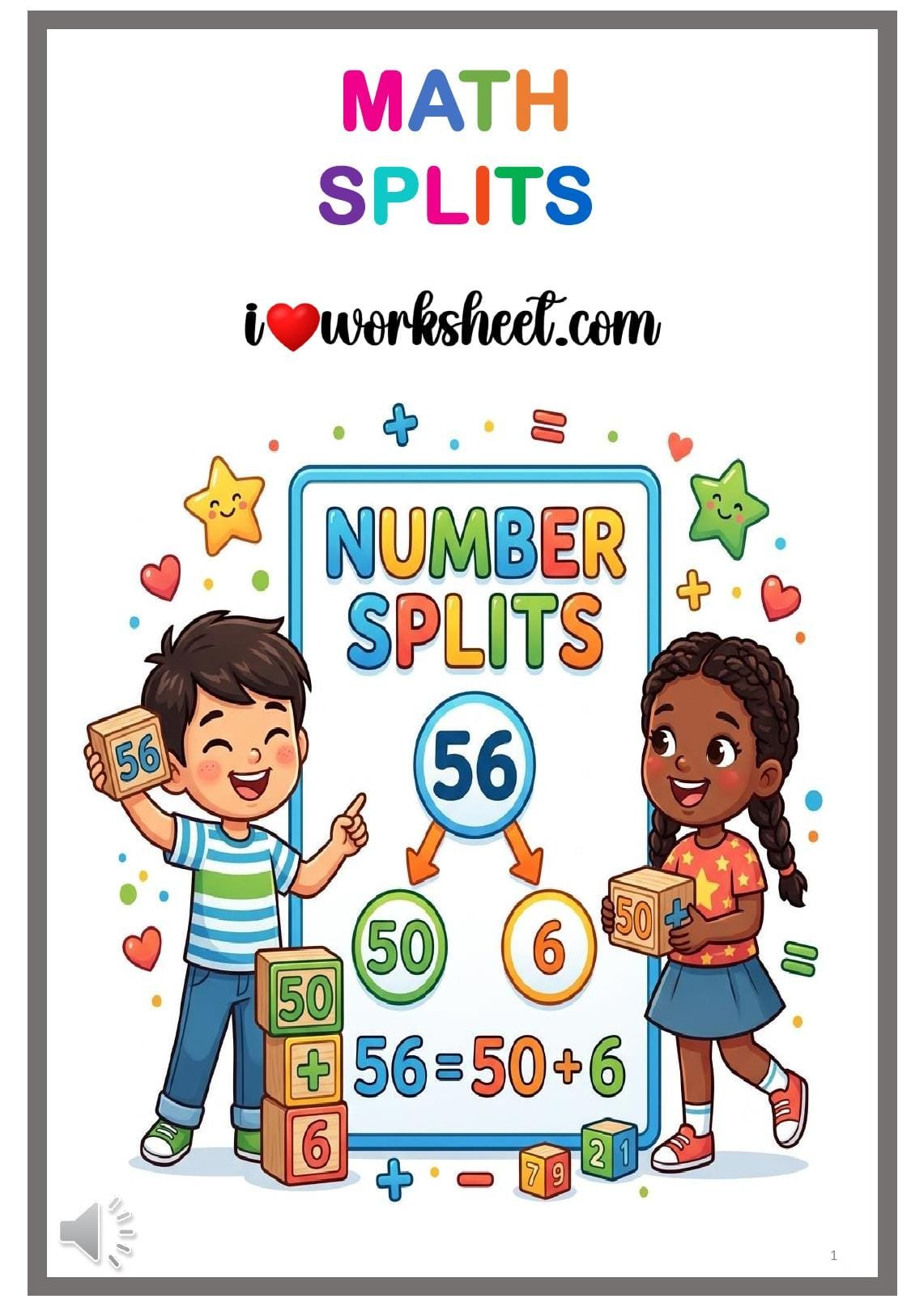
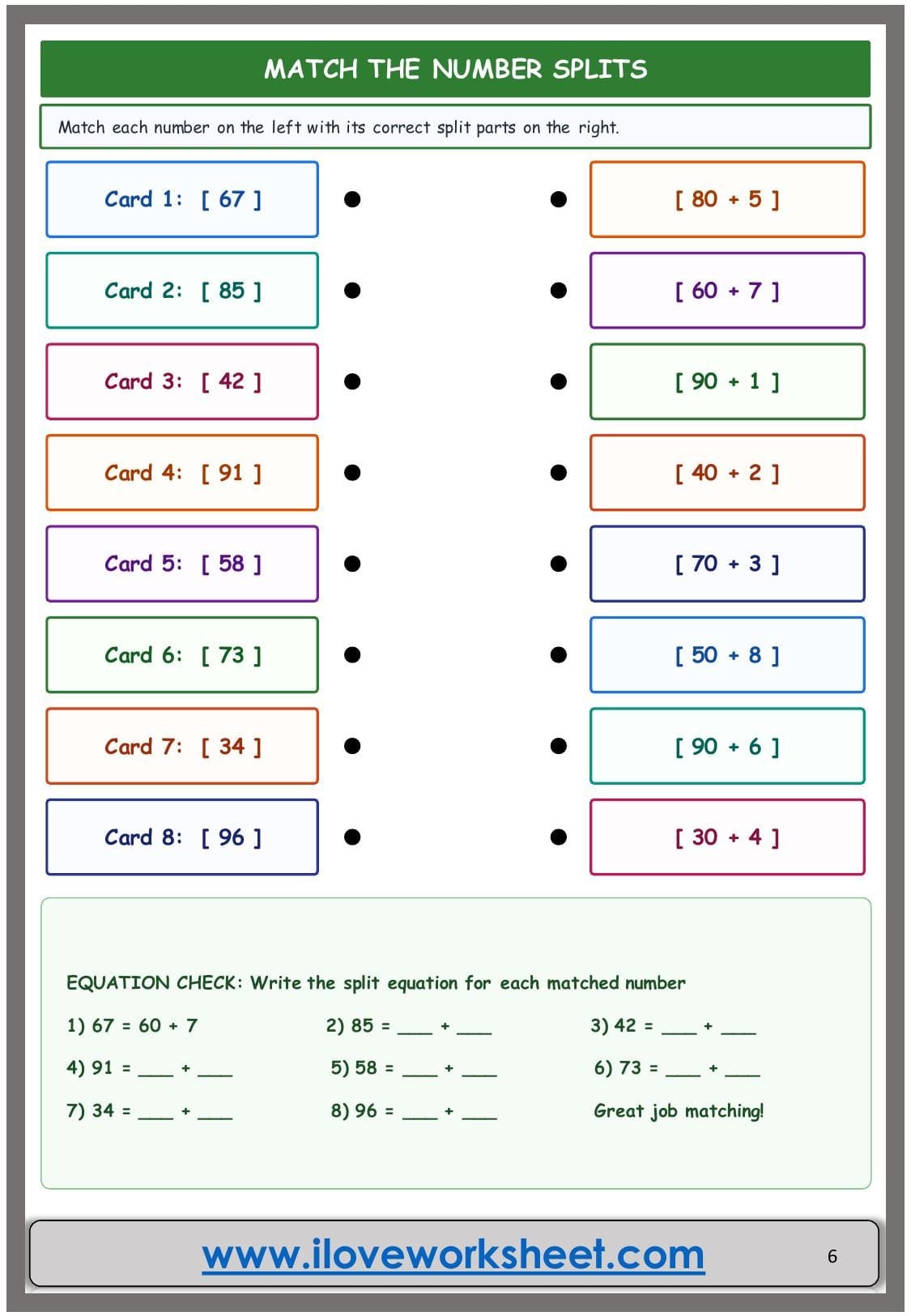
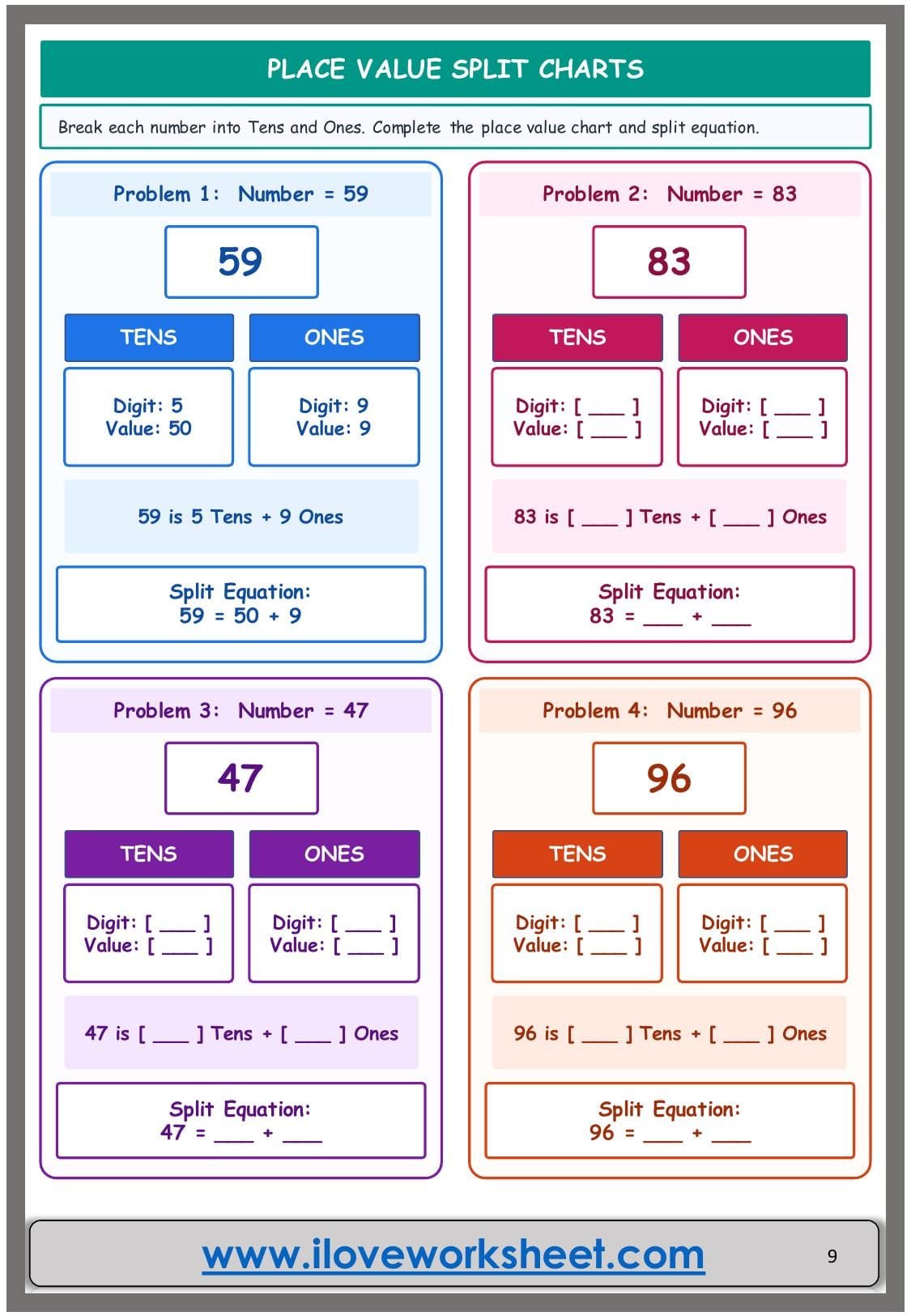
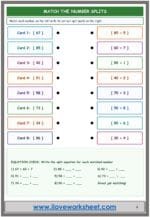

Number decomposition, commonly referred to as number splits or partitioning, represents one of the most vital stepping stones in elementary mathematical education. When children learn to deconstruct two-digit and three-digit numbers into manageable constituent parts (primarily tens and ones), they develop an intuitive grasp of the base-ten number system. Rather than viewing numbers as static symbols or rigid sequences, young learners perceive numbers as flexible quantities that can be assembled, separated, and reassembled to simplify complex computational tasks.
In early elementary grades, arithmetic instruction often transitions rapidly from concrete object counting to abstract symbolic algorithms. Students who lack a solid grounding in number splitting frequently struggle with multidigit addition, mental subtraction, and standard regrouping procedures. Conversely, systematic practice with number splits establishes a robust bridge between concrete visual models and symbolic numerical fluency. By breaking numbers such as 47 into 40 and 7, children reinforce place value architecture while cultivating mental math dexterity.
Educational research consistently demonstrates that early computational confidence stems from conceptual decomposition rather than rote memorization. When primary pupils master the art of number partitioning, arithmetic ceases to be an intimidating collection of mechanical steps. Instead, numbers transform into intuitive building blocks that empower independent problem-solving across diverse elementary math domains.
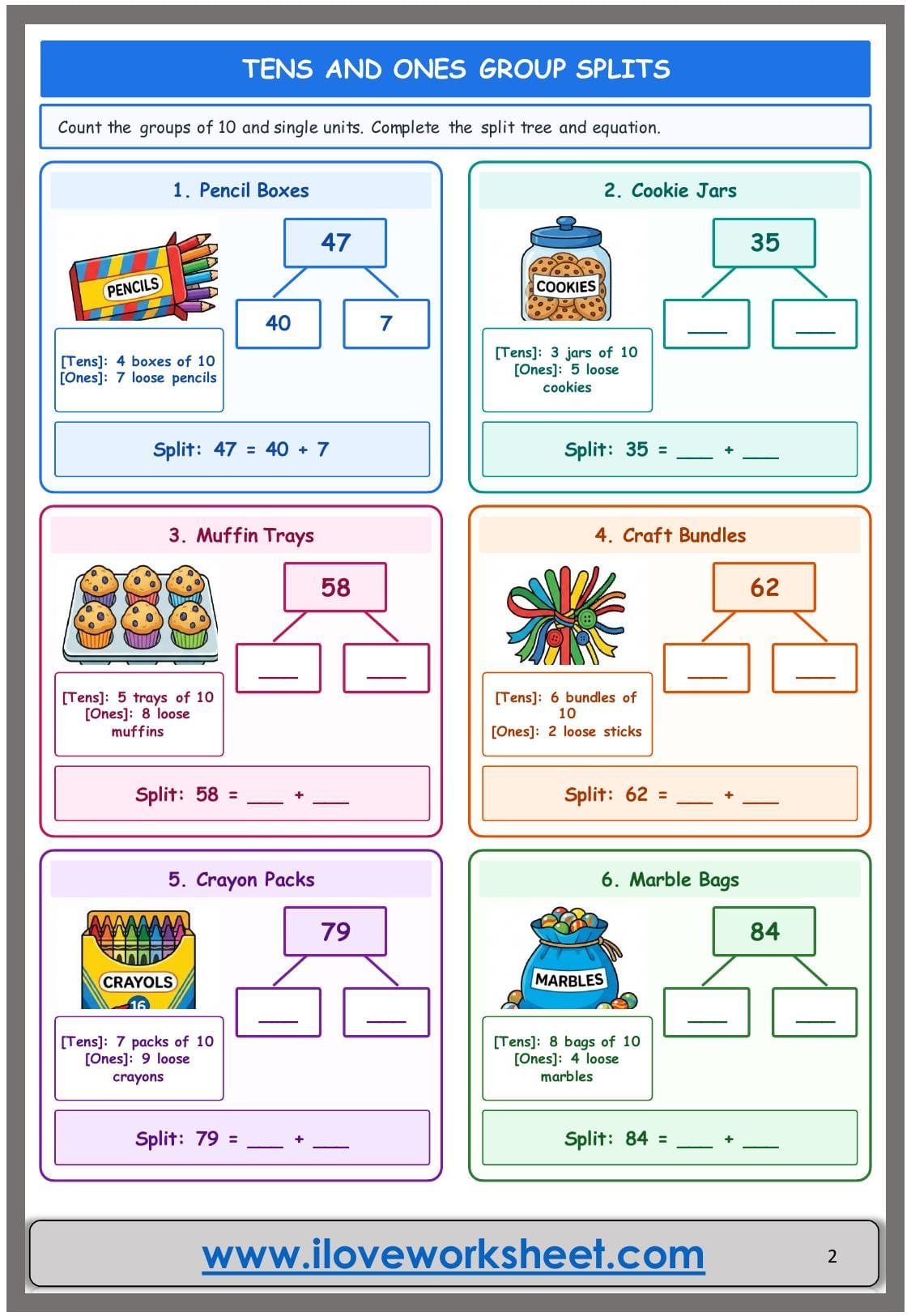
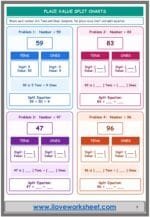
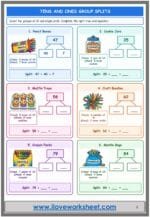
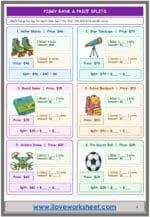
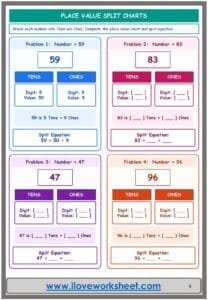
At the core of the split strategy lies place value comprehension. Each numeral in a multi-digit number carries positional value dictated by powers of ten. When students examine a physical bundle of forty-seven items organized into four boxes of ten and seven single units, the spatial layout directly reflects the base-ten positional system. Structured worksheets that pair physical representations (such as pencil boxes, cookie jars, and base-ten blocks) with split tree diagrams enable children to internalize the relationship between grouped quantities and standard digits.
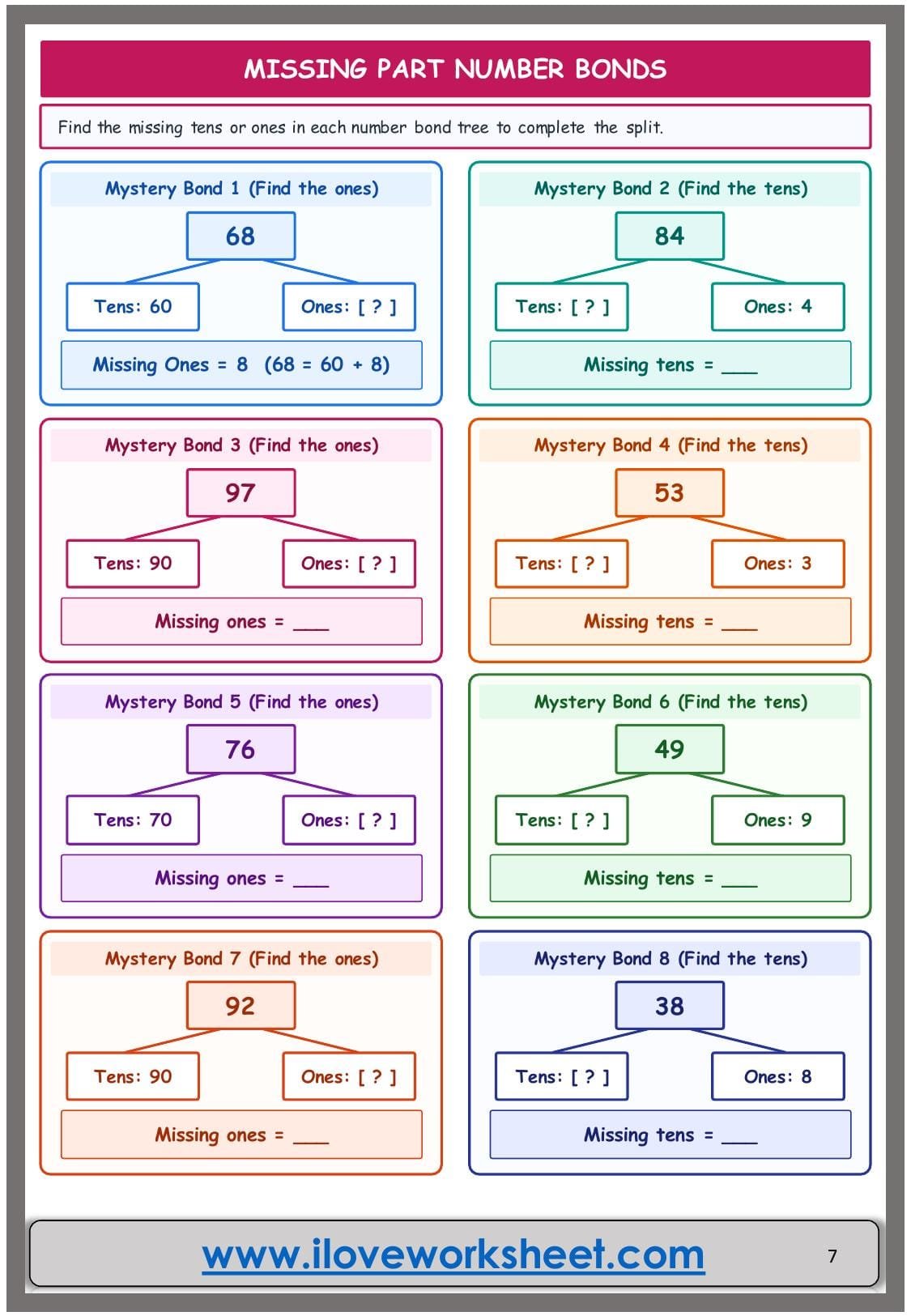
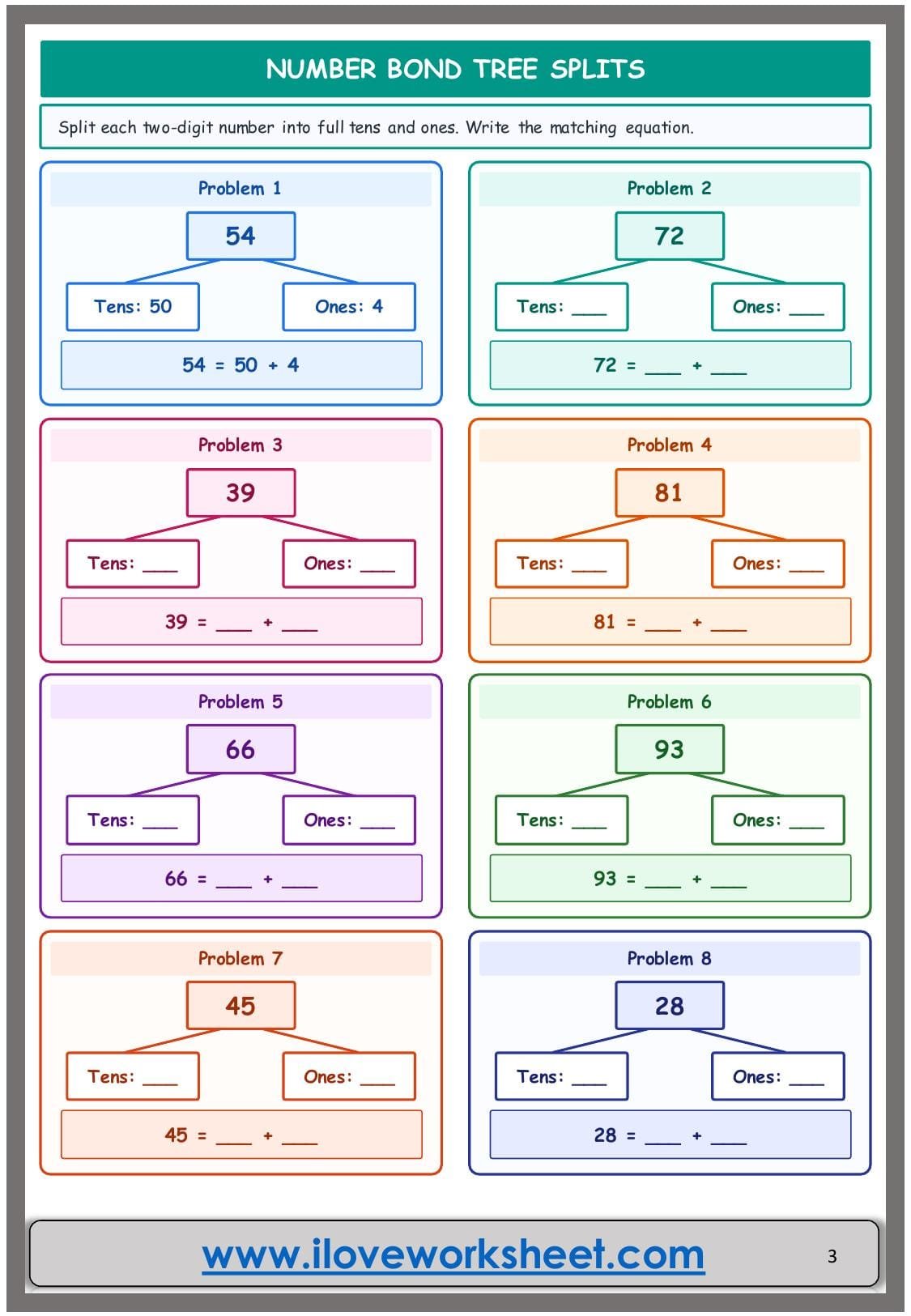
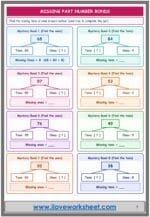
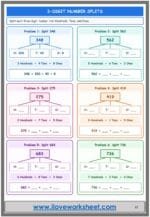
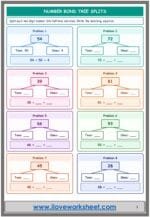
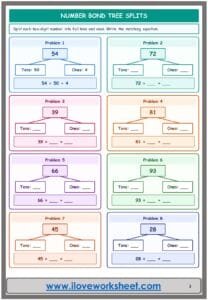
Number bond trees serve as a powerful graphical scaffold. The apex of the tree displays the whole number, while the descending branches illustrate the distinct tens and ones components. This visual model establishes dual cognitive pathways: children simultaneously recognize that the parts combine to form the whole, and that the whole decomposes cleanly into the parts. Mastery of this bidirectional relationship prevents common arithmetic errors, such as treating the digit 4 in 47 as an isolated four rather than forty units.
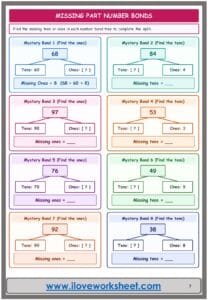
Furthermore, number bond structures bridge the conceptual gap between arithmetic operations and early algebraic thinking. When children examine a split tree containing an unknown part, they naturally engage in missing-addend reasoning. This foundational exposure prepares young minds for formal equation balancing in later school years.
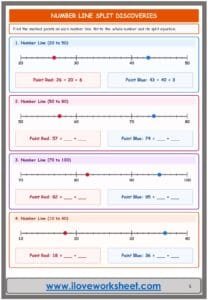
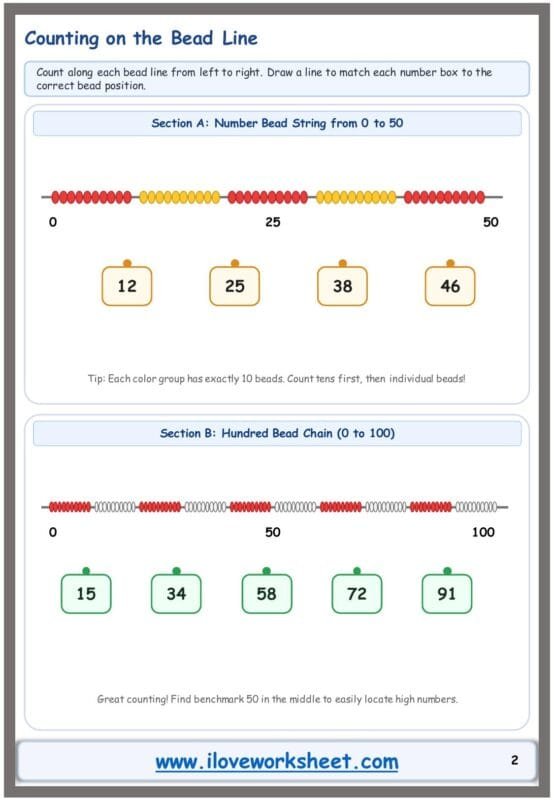
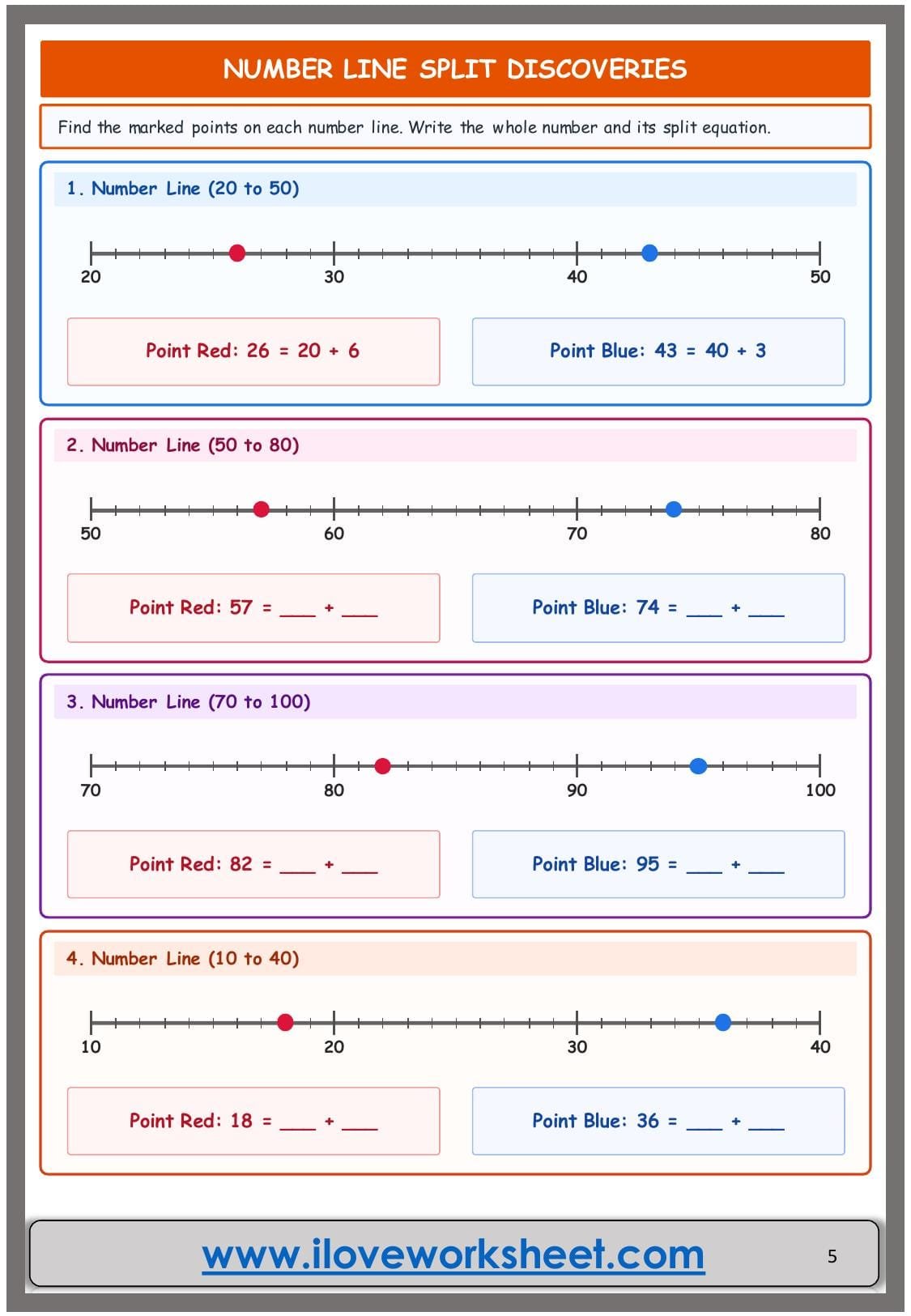
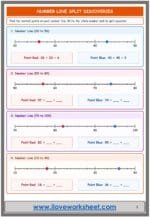
Number lines provide an indispensable linear perspective on number magnitude and partition structure. By observing numbers placed along calibrated decade intervals (such as 20 to 50 or 50 to 80), students develop proportional spatial reasoning. When a student locates the number 57 between 50 and 60, the visual distance from the lower anchor of 50 instantly reinforces the split equation 57 = 50 + 7.
Integrating color-coded markers along number lines enhances visual distinction. When multiple points appear on a single calibrated line, children compare relative positions, evaluate proximity to landmark multiples of ten, and articulate corresponding decomposition statements. This linear reinforcement complements tree diagrams and table layouts, ensuring that learners encounter mathematical concepts across diverse visual modalities.
The continuous nature of the number line also helps prevent common misconceptions regarding discrete counting. By visualizing numbers as continuous positions along a metric continuum, students gain an innate appreciation for number density, measurement principles, and interval spacing.
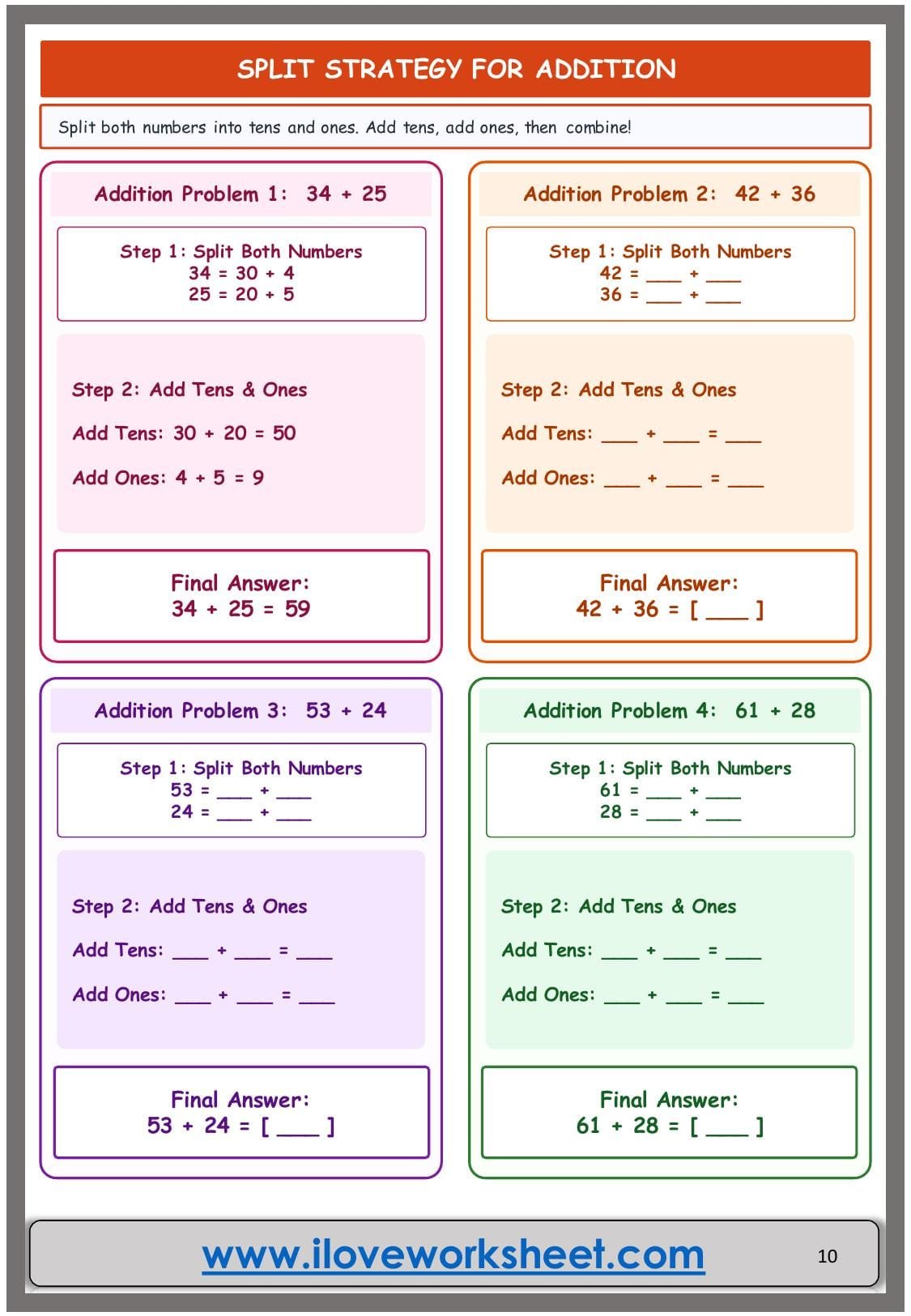
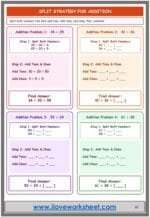
The split strategy transforms complex two-digit addition into a series of transparent, manageable mental steps. When adding numbers like 34 and 25, young mathematicians frequently experience cognitive overload if forced to compute the sum monolithically. By decomposing both addends into full tens (30 + 20) and single ones (4 + 5), the calculation resolves into two straightforward operations: 30 plus 20 equals 50, and 4 plus 5 equals 9. Combining these intermediate totals yields 59 with minimal cognitive friction.
Key stages of the split addition strategy include:
This structured sequence eliminates reliance on rote counting on fingers, instills procedural confidence, and prepares elementary students for mental math challenges in advanced grades.
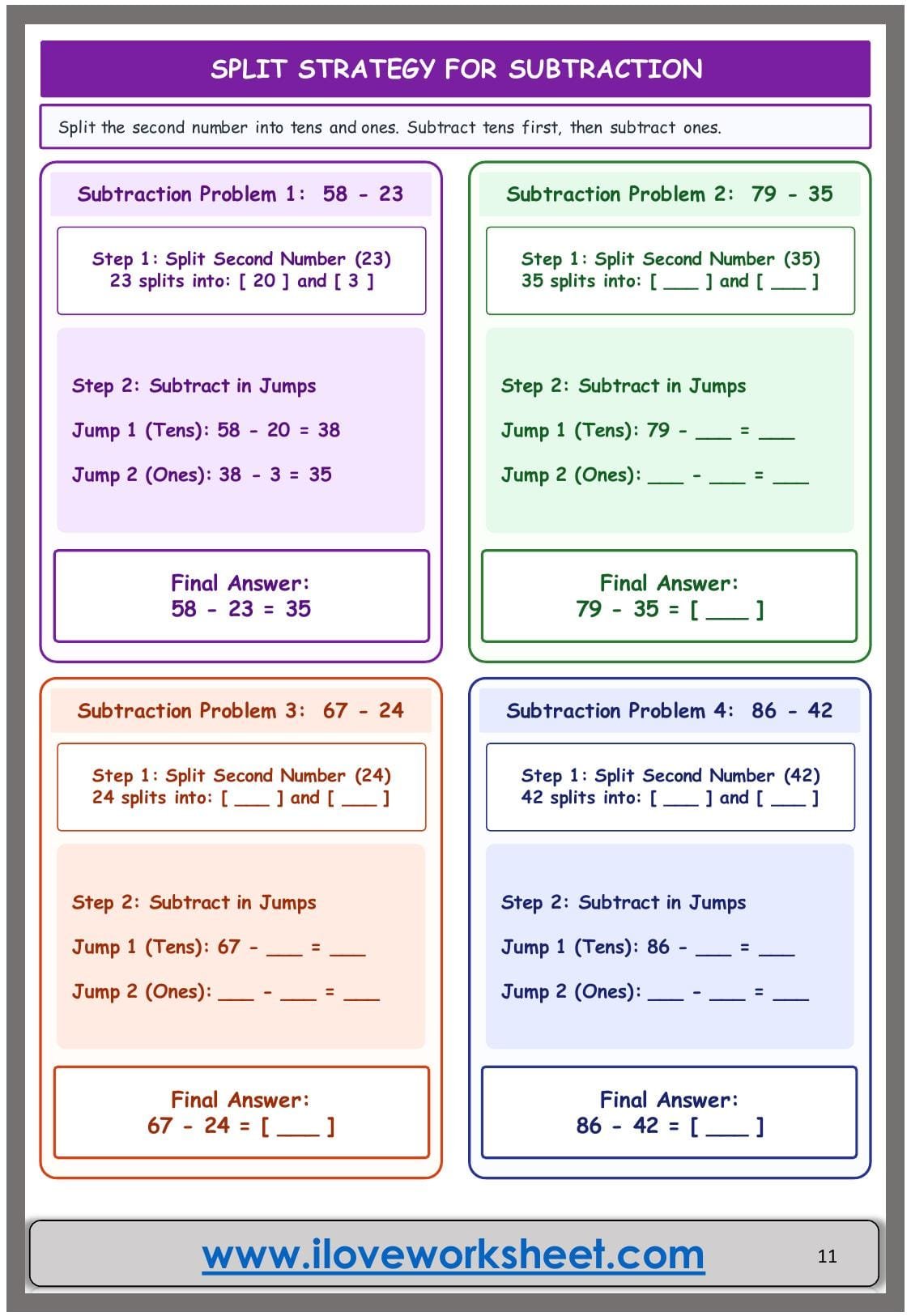
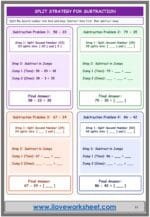
Subtraction often presents greater pedagogical hurdles than addition, particularly when mental calculation is required. The split jump strategy addresses this hurdle by breaking the subtrahend into manageable chunks. In an equation such as 58 – 23, the subtrahend 23 splits into 20 and 3. The learner first executes a large backward jump across full tens (58 – 20 = 38), followed by a precise single-unit decrement (38 – 3 = 35).
Sequential subtraction jumps offer multiple educational advantages:
Through repeated engagement with structured subtraction worksheets, children develop fluid mental trajectories that make multidigit subtraction intuitive and stress-free.
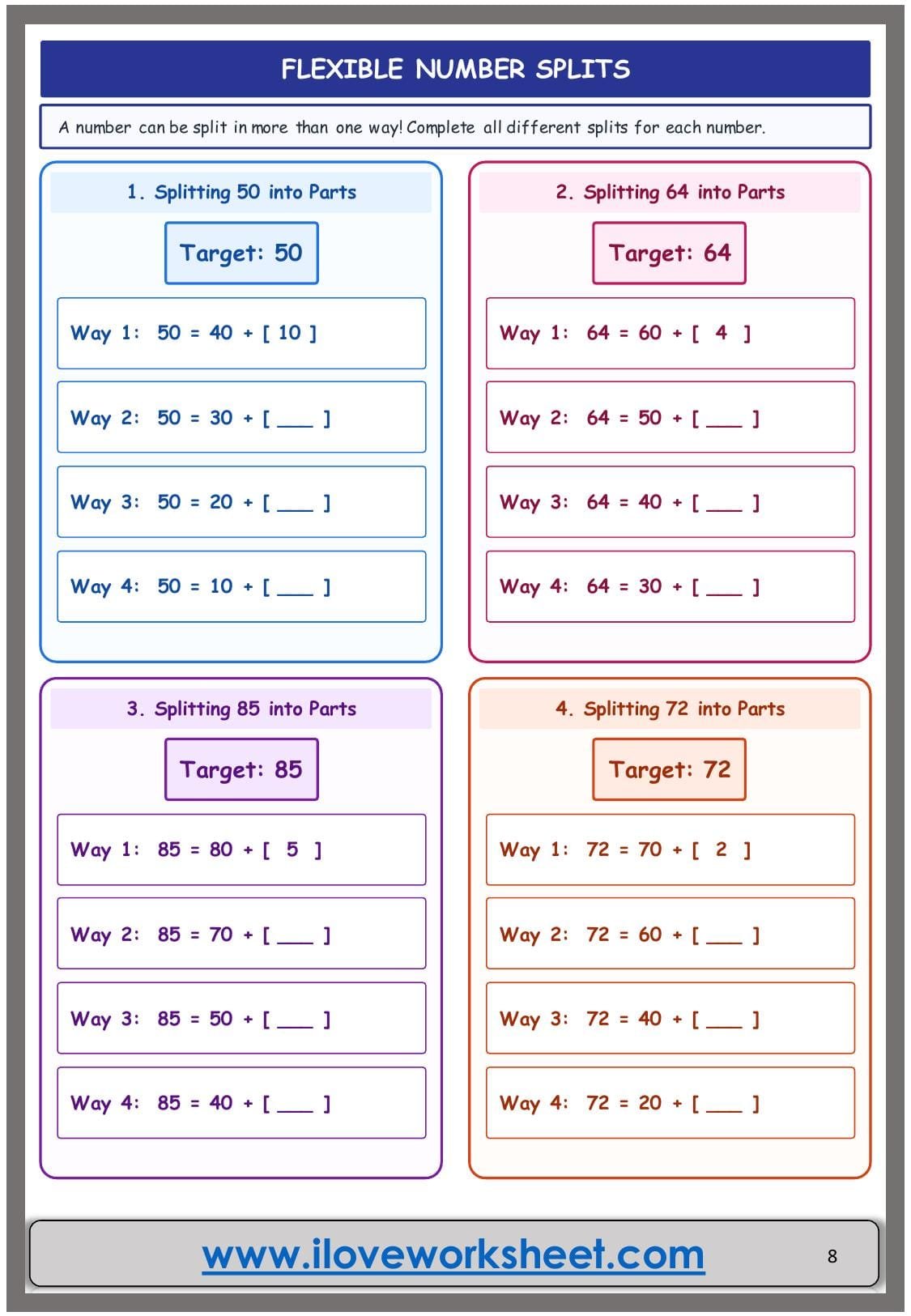
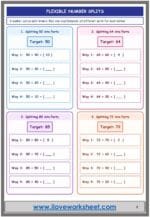
While standard place value partitioning separates numbers strictly into canonical tens and ones (for example, 64 = 60 + 4), mathematical flexibility demands competence in non-standard splits. Understanding that 64 also equals 50 + 14, 40 + 24, and 30 + 34 is essential for mastering formal regrouping algorithms and mental subtraction across decade boundaries.
When children explore flexible partitioning, they discover the conservation of number quantity across varying configurations. Exercises requiring students to complete four distinct split combinations for a single target number expand algebraic intuition. Children realize that shifting ten units from one part to another preserves the overall sum. This foundational insight demystifies the mechanics of borrowing and carrying in standard column arithmetic.
Moreover, flexible decomposition directly supports mental computation in real-time scenarios. When a student calculates change or balances quantities, selecting an adaptive partition rather than a rigid canonical split often simplifies mental arithmetic substantially.
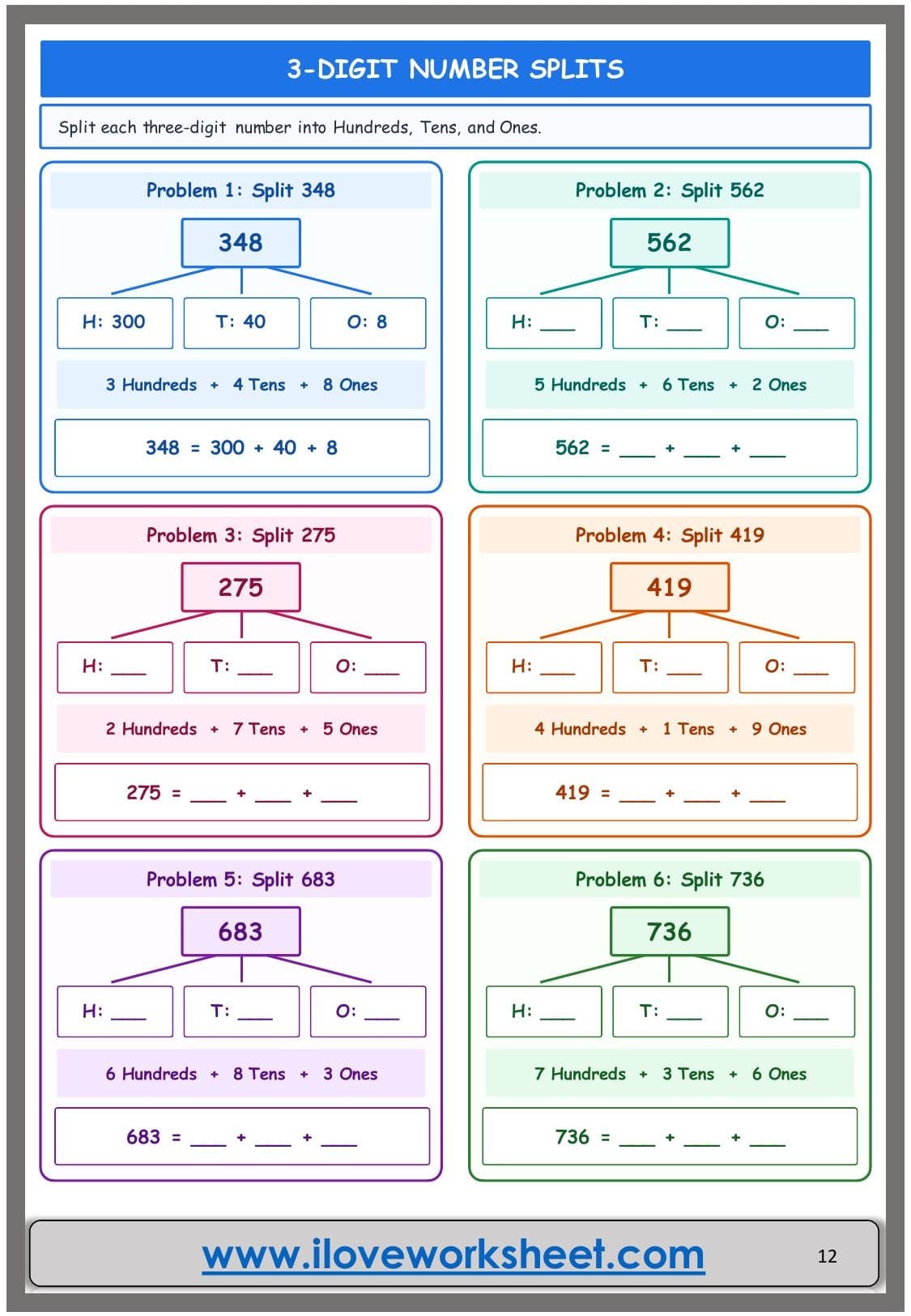
As mathematical curricula progress into upper primary levels, the split strategy seamlessly scales to three-digit integers. Decomposing numbers such as 348 into 300, 40, and 8 reinforces the hierarchical nature of the place value system. Students identify three hundreds, four tens, and eight ones, articulating expanded notation equations (348 = 300 + 40 + 8) with ease.
Three-digit split exercises reinforce the symmetry of the decimal system. Whether working with two-digit or multi-hundred quantities, the underlying principles of decomposition remain constant. This conceptual continuity provides elementary learners with a sense of mastery and readiness for higher-level arithmetic, including long multiplication and partial-quotient division.
By observing that hundreds decompose into ten tens, and tens decompose into ten ones, children grasp the base-ten multiplier mechanism that underpins the entire international metric and numerical apparatus.
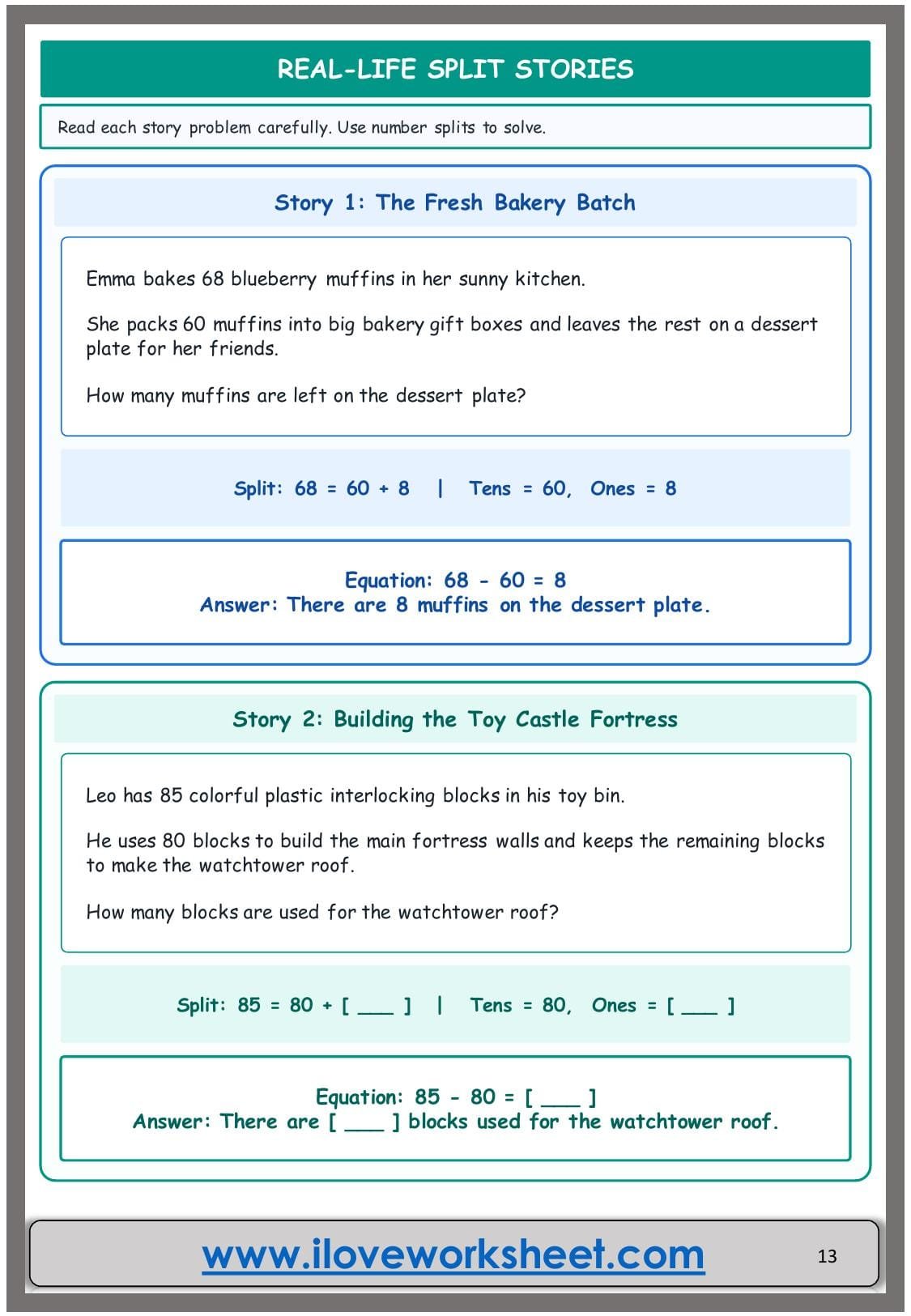
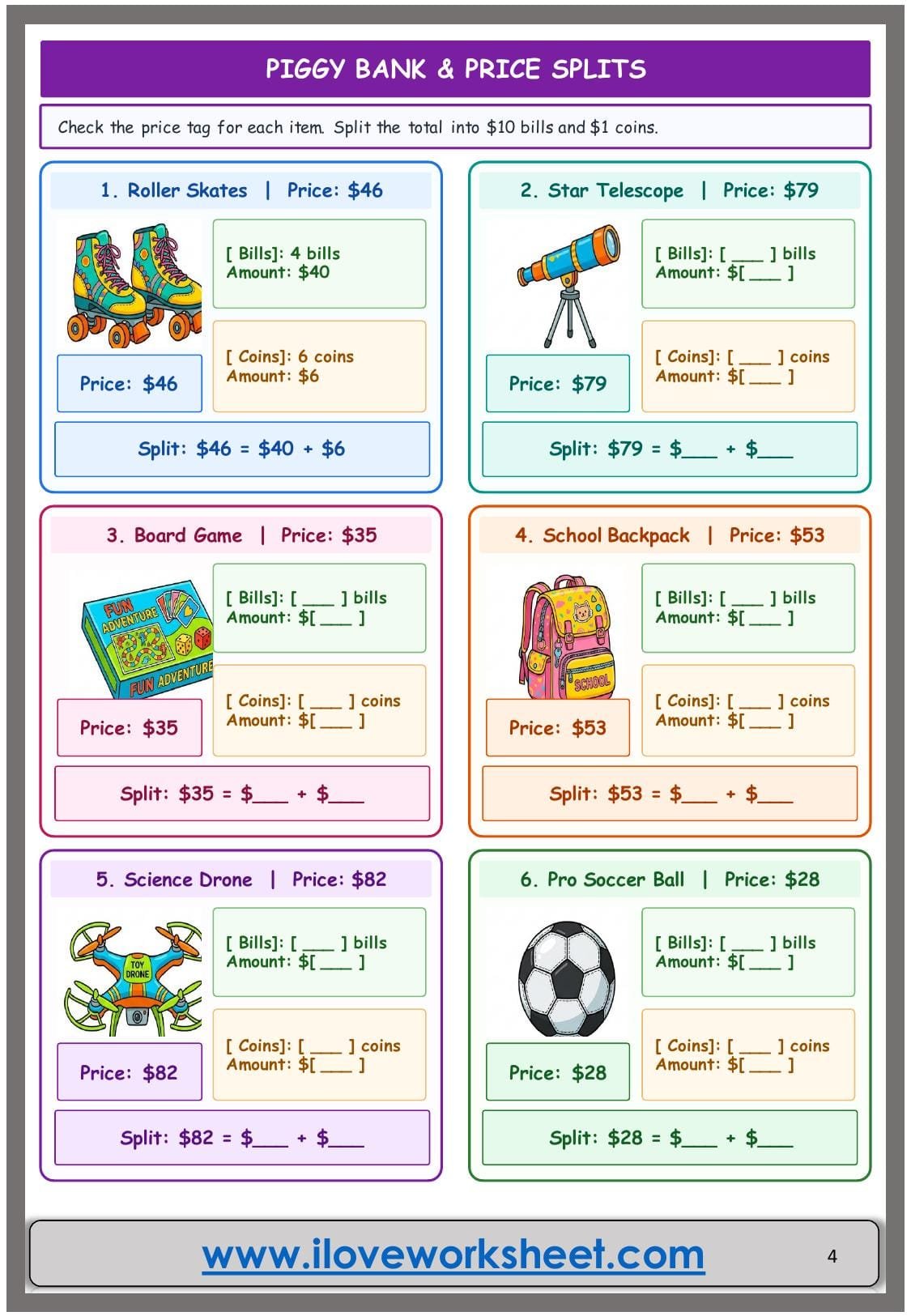
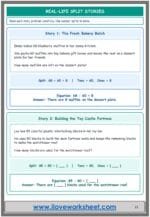
Abstract numerical operations gain immediate relevance when embedded in relatable story problems. Scenarios involving bakery batches, toy construction blocks, harvested fruit, and library book collections provide authentic contexts for number splitting. When a word problem states that a baker prepares 68 muffins and packages 60 into gift boxes, the child recognizes the problem structure as a direct tens-and-ones decomposition (68 = 60 + 8).
Story-based problem solving cultivates mathematical modeling capabilities. Students learn to translate descriptive prose into symbolic equations, perform necessary split computations, and articulate answers with appropriate contextual units. This contextual bridge ensures that computational proficiency translates into practical problem-solving capability in everyday life.
When mathematical concepts connect directly to familiar childhood experiences, student motivation rises exponentially. Mathematics shifts from an isolated classroom exercise to an engaging lens for understanding the surrounding world.
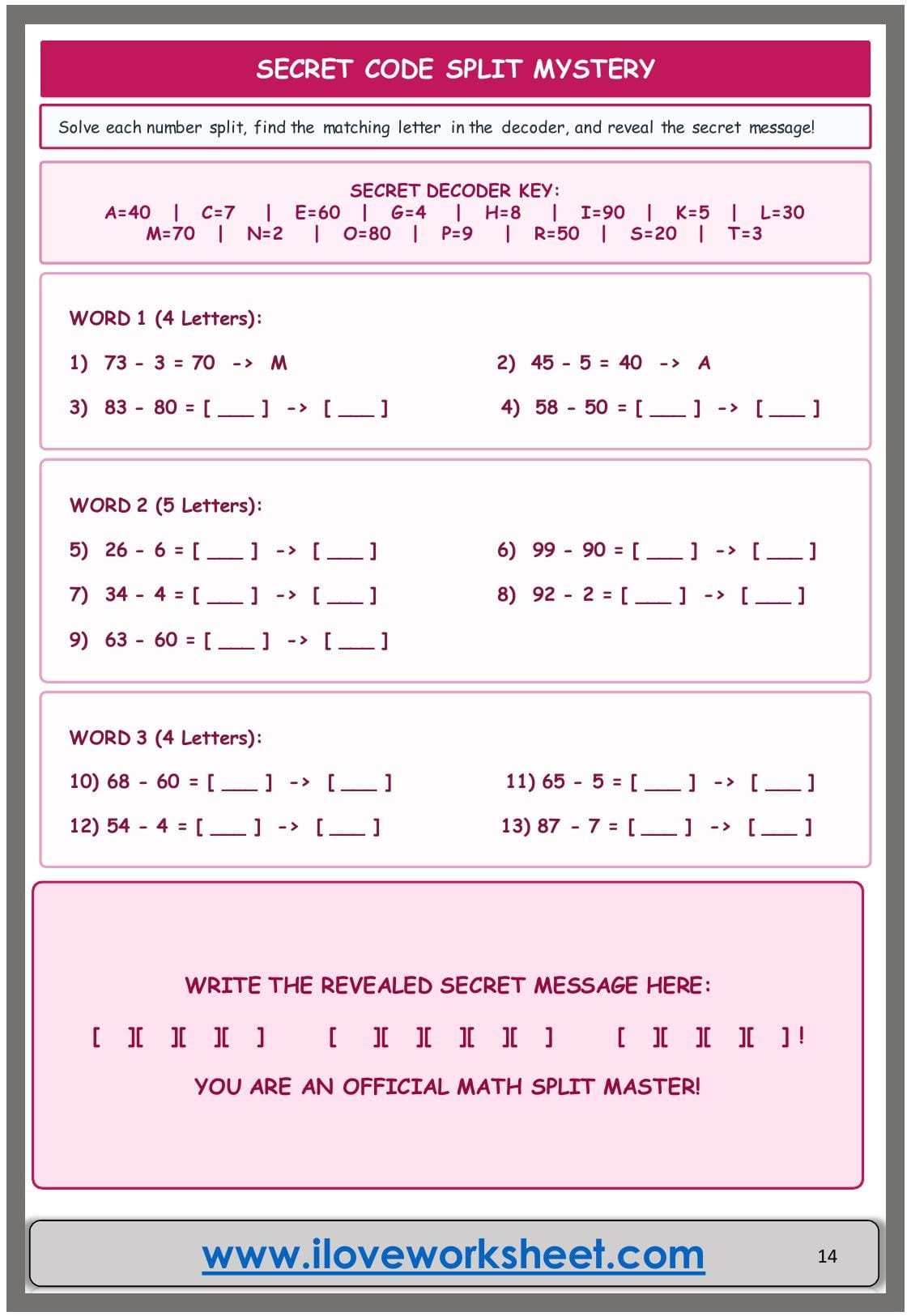
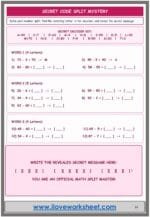
Student engagement flourishes when practice routines incorporate gamified problem structures. Secret decoder puzzles challenge learners to solve individual split calculations to unlock letters and spell hidden messages. This playful format provides immediate intrinsic feedback; an incorrect calculation disrupts the secret word, prompting self-directed error analysis and correction.
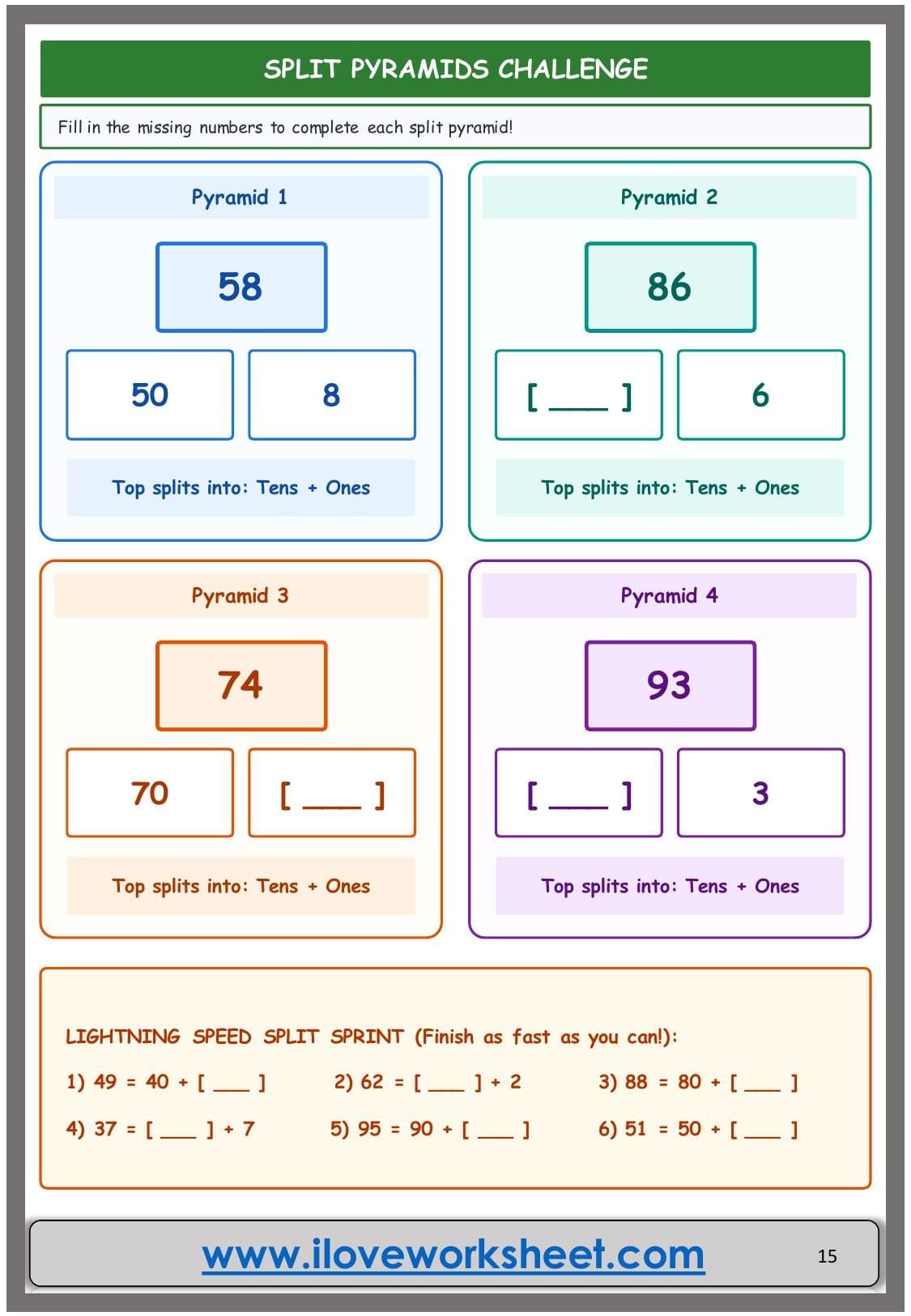
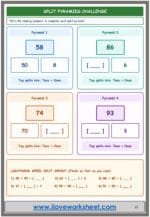
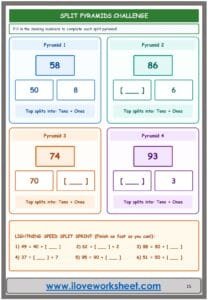
Similarly, number split pyramids introduce hierarchical puzzle mechanics. Children analyze the apex number and determine missing baseline addends. Combining structured analytical worksheets with high-energy speed sprints builds computational automaticity while maintaining enthusiasm and joy in mathematical discovery.
Through diverse presentation formats (ranging from structured tables and visual trees to interactive decoder challenges and timed sprints), elementary math programs ensure sustained learner engagement and deep conceptual retention.