Kindergarten Simple Counting: Pedagogical Strategies, Visual Frameworks, and Early Number Sense Development
Foundational Principles of Kindergarten Simple Counting and Early Number Sense
Early childhood mathematical development establishes the cognitive architecture for future academic success. Simple counting forms the initial bridge connecting concrete sensory perceptions with abstract symbolic mathematics. When kindergarten learners engage with numbers, they transition from basic rote vocalization to deep conceptual cardinality, recognizing that a spoken number word corresponds directly to a tangible quantity of items.
Cognitive research demonstrates that young minds thrive when mathematical instruction blends multi-sensory experiences with structured visual models. Early numeracy consists of several interconnected milestones, including stable order counting, one-to-one correspondence, cardinality, and hierarchical inclusion. Mastering these foundational stages prevents cognitive overload as learners advance to multi-digit arithmetic, place value comprehension, and algebraic reasoning.
The Power of Concrete and Visual Number Representations in Early Childhood
Visual models serve as cognitive anchors that facilitate immediate numerical comprehension. In the earliest stages of learning, children interact with physical counters, beads, and tactile blocks. As abstraction develops, pictorial representations provide an essential bridge between tangible objects and numeric numerals.
Systematic exposure to varied representations ensures that mathematical concepts remain adaptable across diverse problem-solving scenarios. Presenting quantities through grouped dots, linear tracks, and structured arrays encourages children to visualize mathematical relationships dynamically rather than relying solely on mechanical memorization.
Mastering One-to-One Correspondence and Stable Order Principles
One-to-one correspondence is the foundational ability to pair exactly one number word with each physical or illustrated object in a given set. Young children often recite number names rhythmically without coordinating their speech with their physical pointing gestures. Structured visual counting exercises reinforce this essential coordination by providing clearly separated items that promote deliberate, sequential tracking.
The principle of stable order ensures that number words remain invariant in sequence. Whether counting stars, apples, or geometric shapes, the order of numbers remains universally consistent. Regular structured practice reinforces sequential memory, enabling learners to build automaticity and confidence in numerical order from one to one hundred.
Utilizing Number Bead Strings to Build Linear and Spatial Cardinality
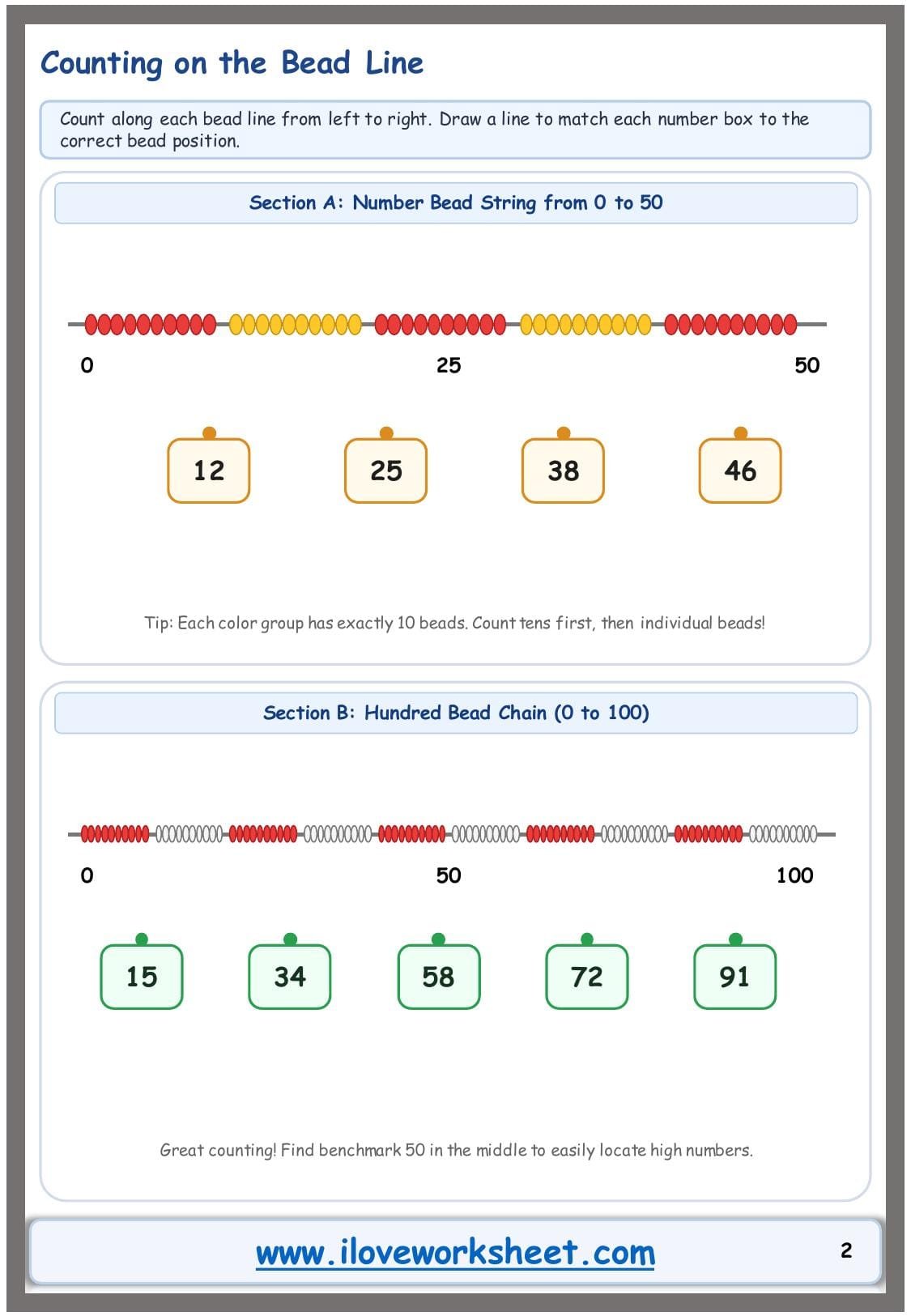
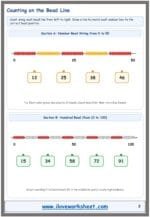
Number bead strings offer an extraordinary visual model for kindergarten mathematics. By organizing beads into alternating color groups of exactly ten beads, bead strings visually demonstrate quantity segmentation and spatial cardinality. Learners observe that fifty beads occupy five distinct ten-bead color blocks along a linear continuum.
Connecting number tags to specific positions on a bead string develops spatial estimation skills. Instead of counting individual beads starting from one every single time, children learn to utilize friendly benchmark numbers such as ten, twenty-five, and fifty. This benchmark anchoring dramatically enhances mental calculation speed and intuitive number sense.
Developing Spatial Estimation and Benchmark Thinking on Number Lines
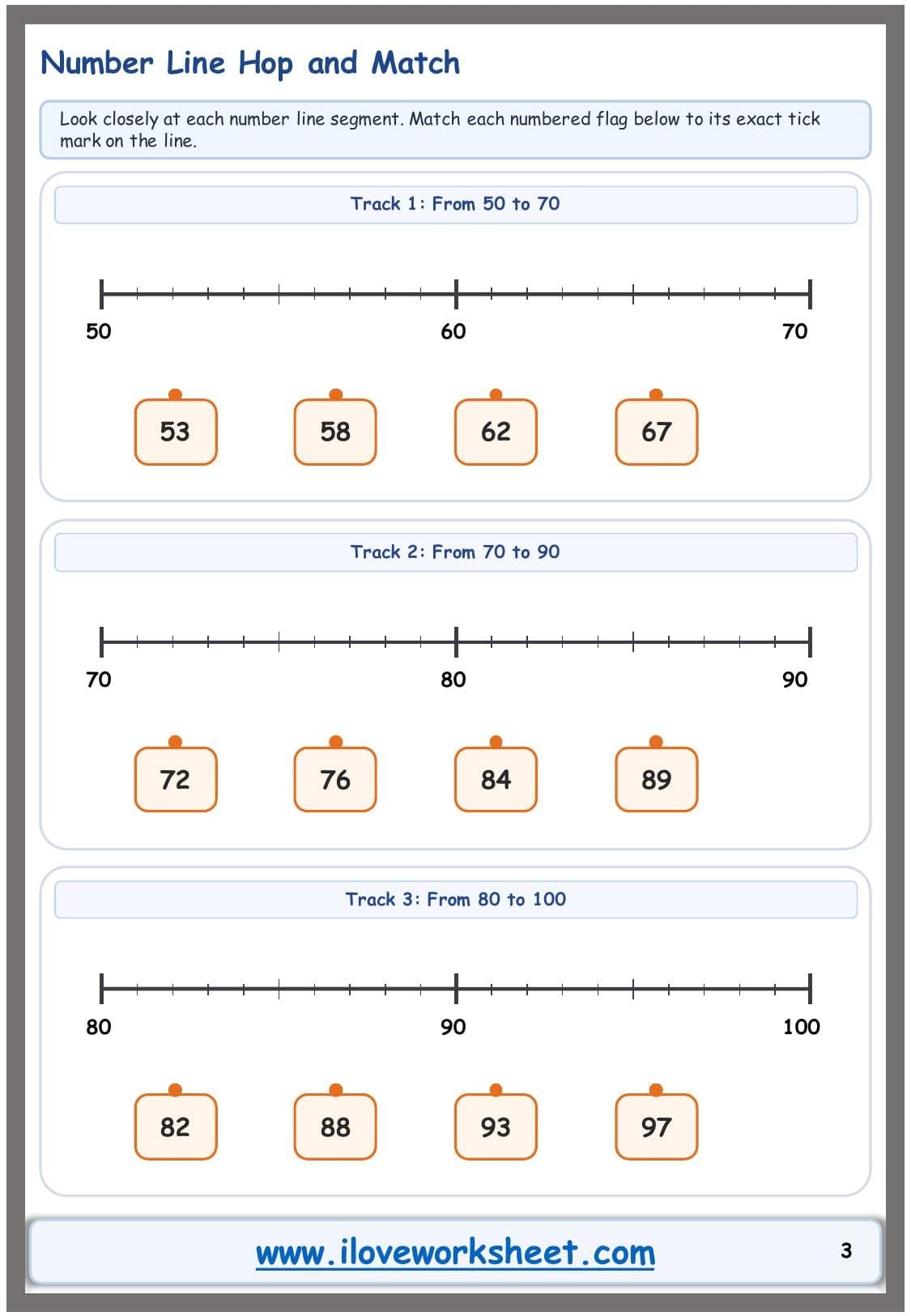
The continuous number line is among the most versatile mathematical representations in elementary education. Unlike discrete counters, a number line depicts numbers as continuous lengths and distances from zero. This spatial orientation prepares kindergarten children for concepts of greater than, less than, measurement intervals, and arithmetic operations.
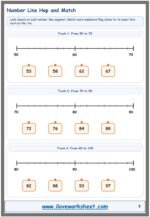
Segmented number lines focused on targeted intervals, such as fifty to seventy or seventy to ninety, allow learners to examine fine-grained numerical increments without visual clutter. By locating numbers relative to major ten-markers, children construct internal mental number lines that support fast estimation and numerical intuition.
Strategies for Identifying Missing Numbers and Bridging Number Sequences
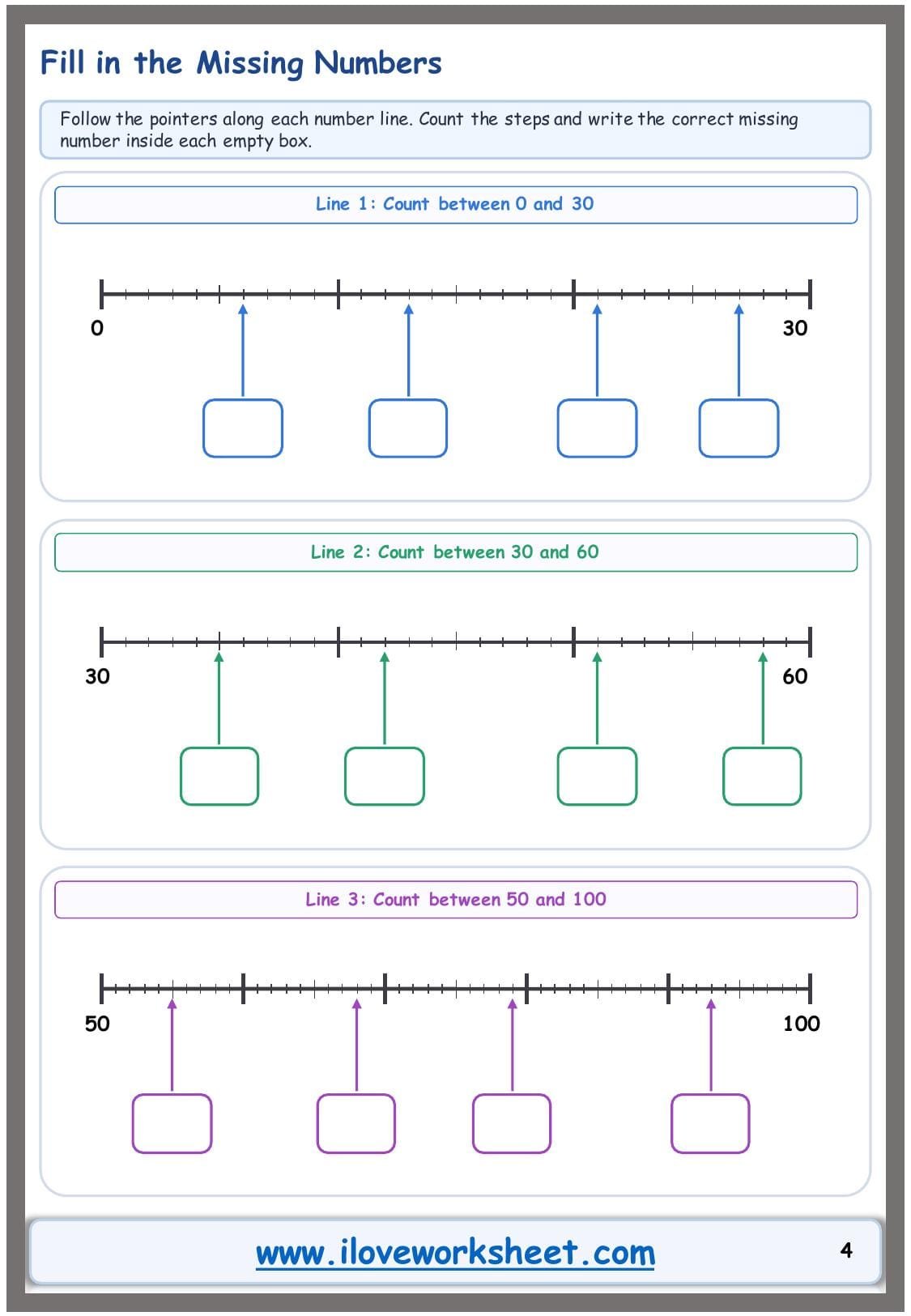
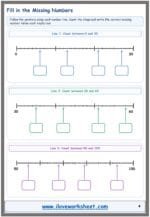
Missing number exercises challenge children to analyze numerical context and deduce sequential patterns. When examining an arrow pointing to an unmarked tick on a number line, learners must first establish the boundary values, calculate the increment value between major ticks, and count forward or backward to pinpoint the exact value.
This problem-solving routine transforms passive counting into active mathematical deduction. Children learn to verify hypotheses by counting on past the target box to ensure that subsequent benchmark values align correctly with their calculated answer.
Vertical Bar Shading and Proportional Quantity Visualization
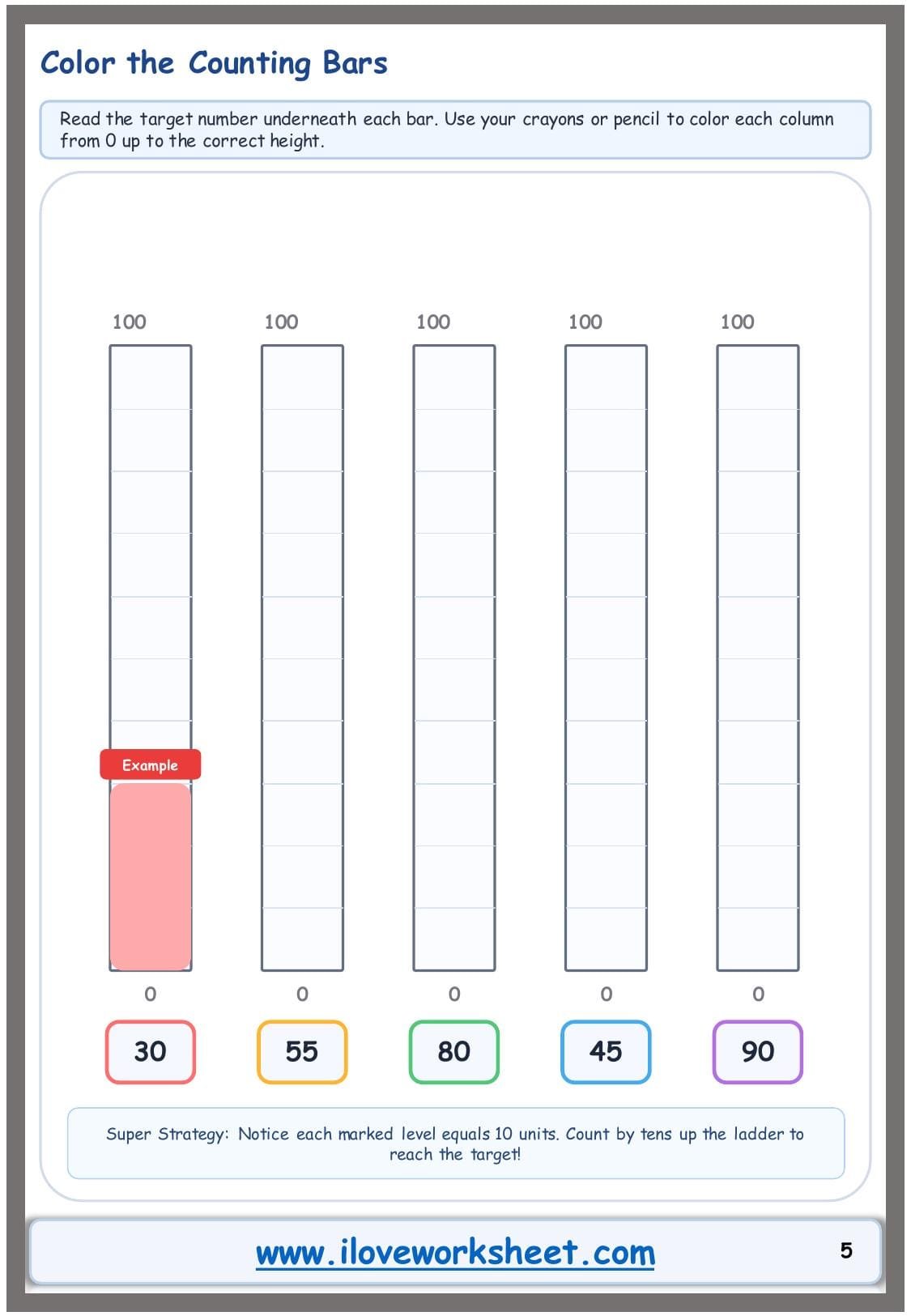
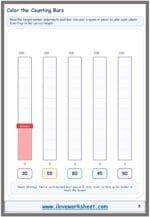
Vertical graduated quantity bars introduce early learners to proportional reasoning and data representation. Shading a column from zero upward to a target number provides a direct visual metaphor for magnitude: higher bars represent larger quantities, while lower bars represent smaller values.
This vertical orientation mimics real-world measurement instruments such as thermometers, liquid volume cylinders, and progress meters. By practicing with graduated intervals of ten units, children connect proportional height with numerical values, reinforcing ten-based structural comprehension in an intuitive format.
Building Place Value Foundations Through Base Ten Rods and Unit Cubes
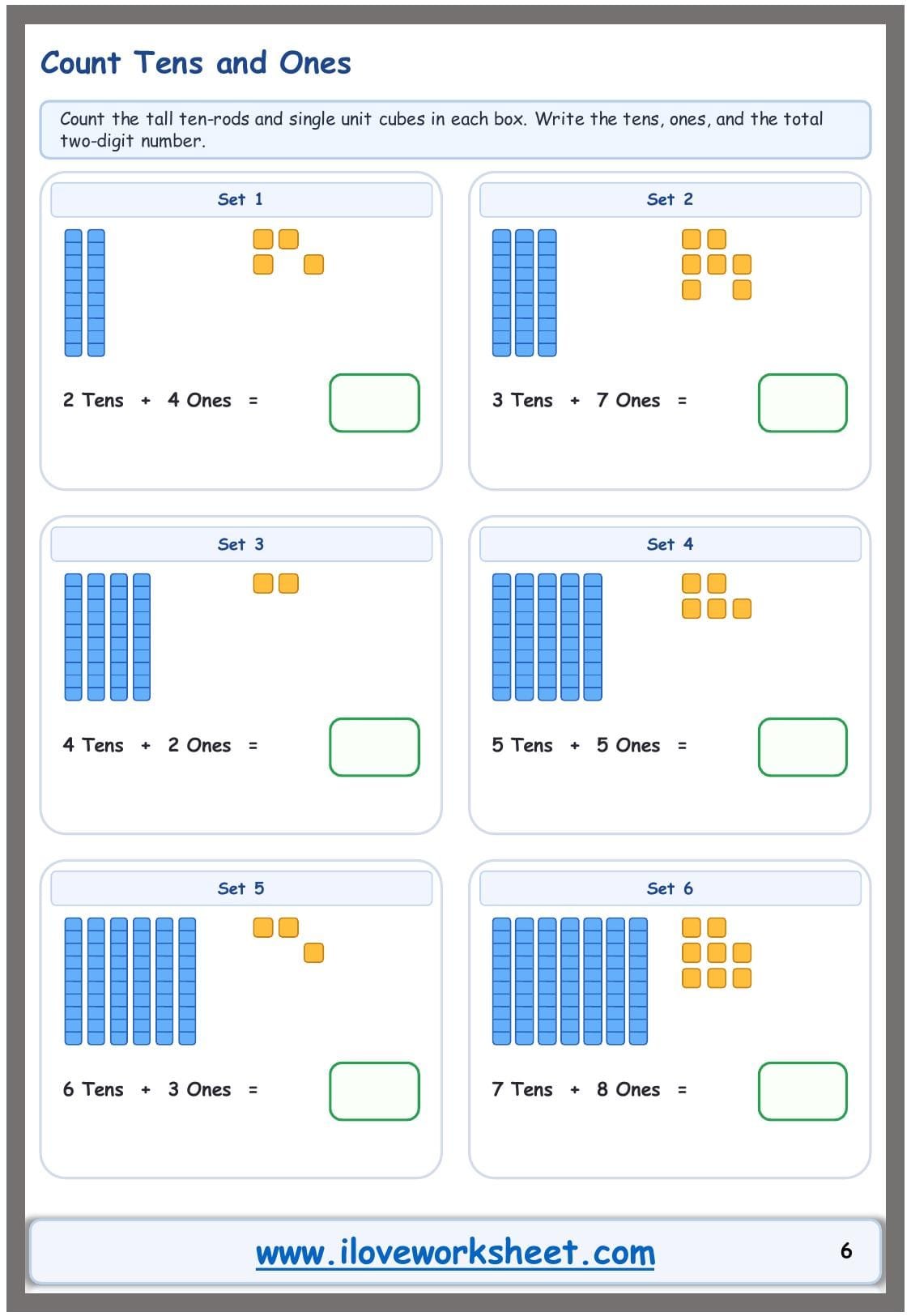
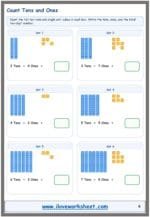
Place value comprehension is the cornerstone of multi-digit arithmetic. Base ten blocks, consisting of ten-rods and single unit cubes, provide a visual demonstration of the decimal number system. Rather than viewing thirty-four as thirty-four disconnected items, children perceive it as three distinct bundles of ten plus four loose units.
Decomposing numbers into tens and ones demystifies two-digit numbers. When kindergarten children routinely identify that seven tens and eight ones equal seventy-eight, they develop the structural awareness required for addition with regrouping, subtraction with borrowing, and mental arithmetic.
Comparative Quantitative Analysis: Object Counting and Relational Symbols
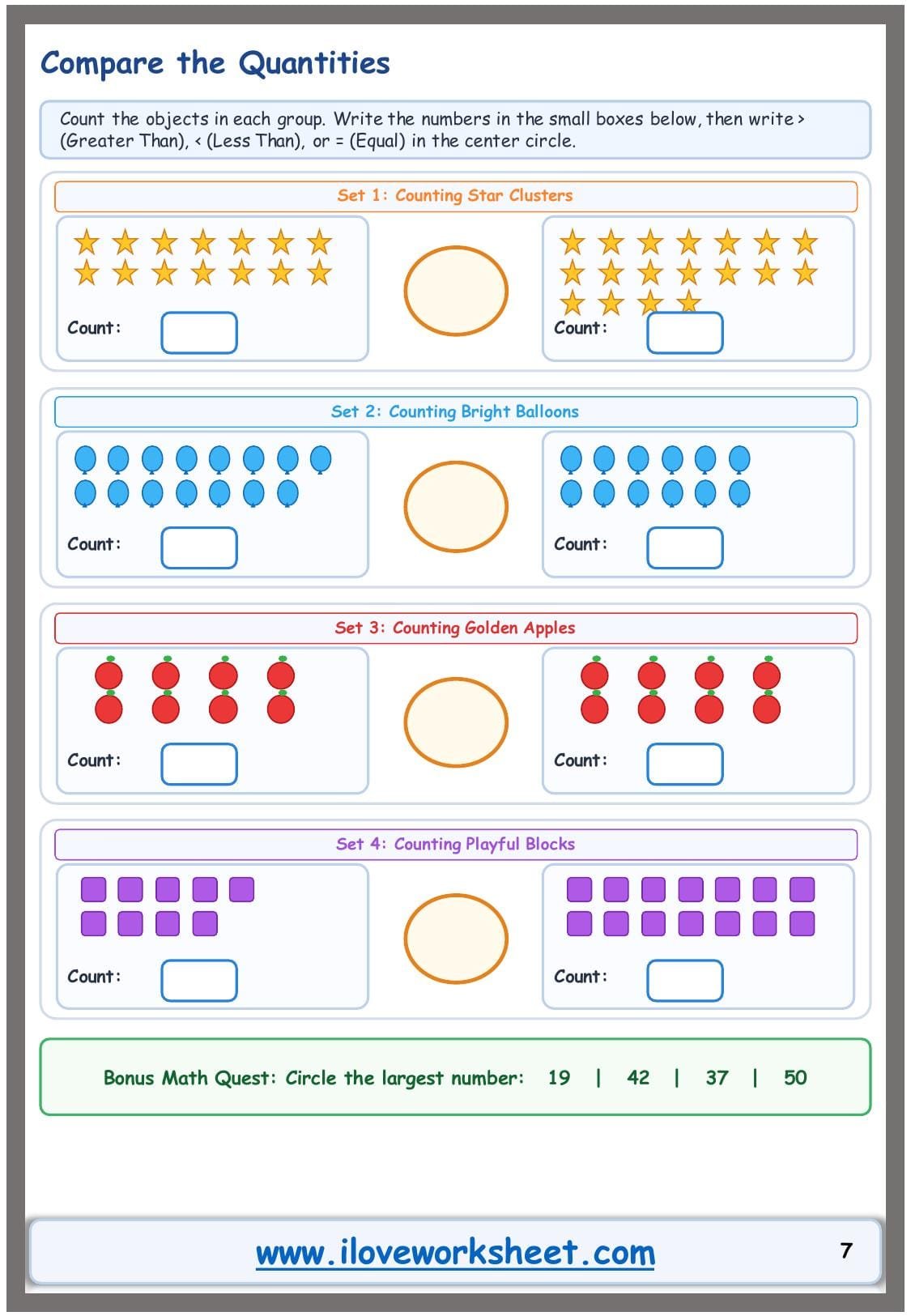
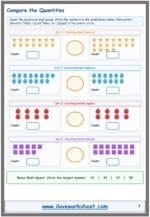
Quantitative comparison requires children to evaluate two distinct magnitudes simultaneously. Early comparisons begin with visual object sets, such as star clusters, balloons, apples, and playful geometric blocks. Children count each visual cluster, record the numeric total in designated count boxes, and apply comparison symbols in a central comparison circle.
Rigorous comparison practice encourages children to examine the highest place value first. When comparing counted sets, learners identify relational differences systematically, reinforcing the logical transition from concrete object tracking to symbolic algebraic relations.
Skip Counting Rhythms and Multiplicative Readiness
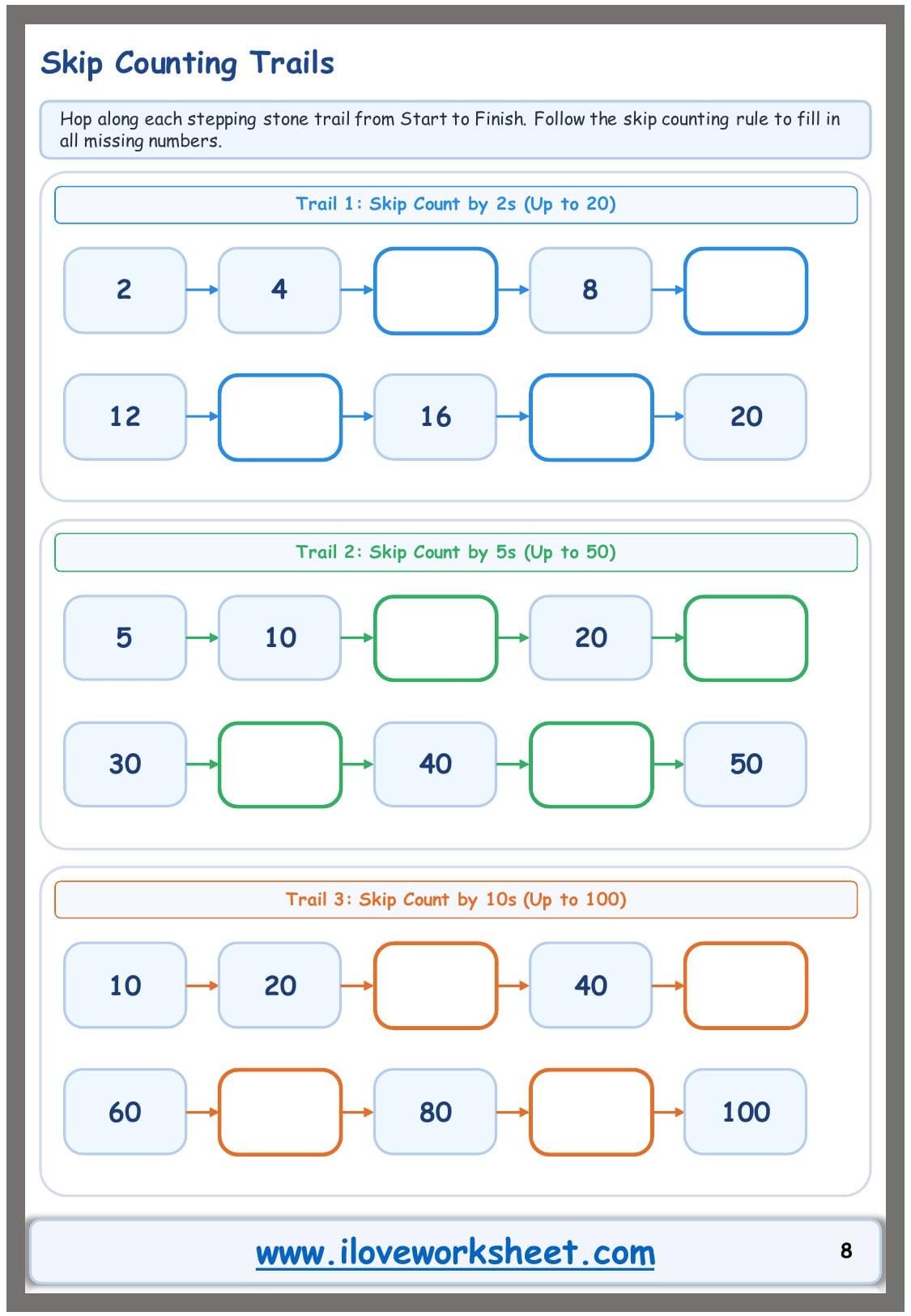
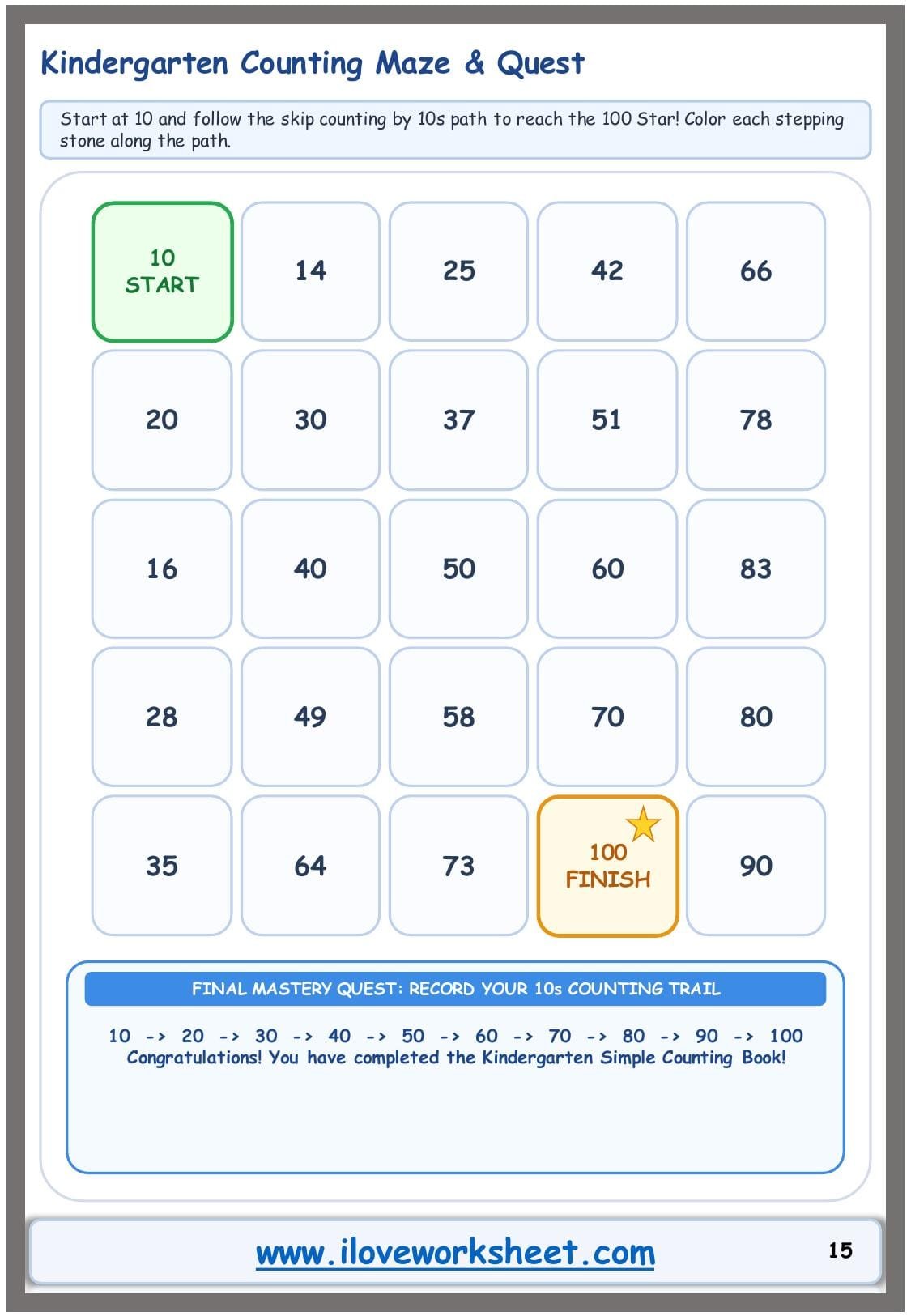
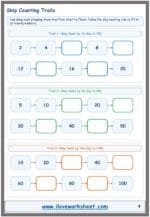
Skip counting by twos, fives, and tens bridges simple counting and multiplicative thinking. Stepping stone trails and sequential number paths turn counting into an engaging pattern-seeking adventure. Children identify rhythmic cadence in number endings, such as the repeating zero-five pattern in fives or the zero pattern in tens.
Skip counting reinforces number flexibility and mental grouping. Counting by tens up to one hundred strengthens decimal fluency, while counting by twos establishes parity awareness and even numbers. These rhythmic exercises establish automaticity that pays dividends across all elementary mathematics curricula.
Integrating Gamified Mystery Codes to Enhance Student Engagement
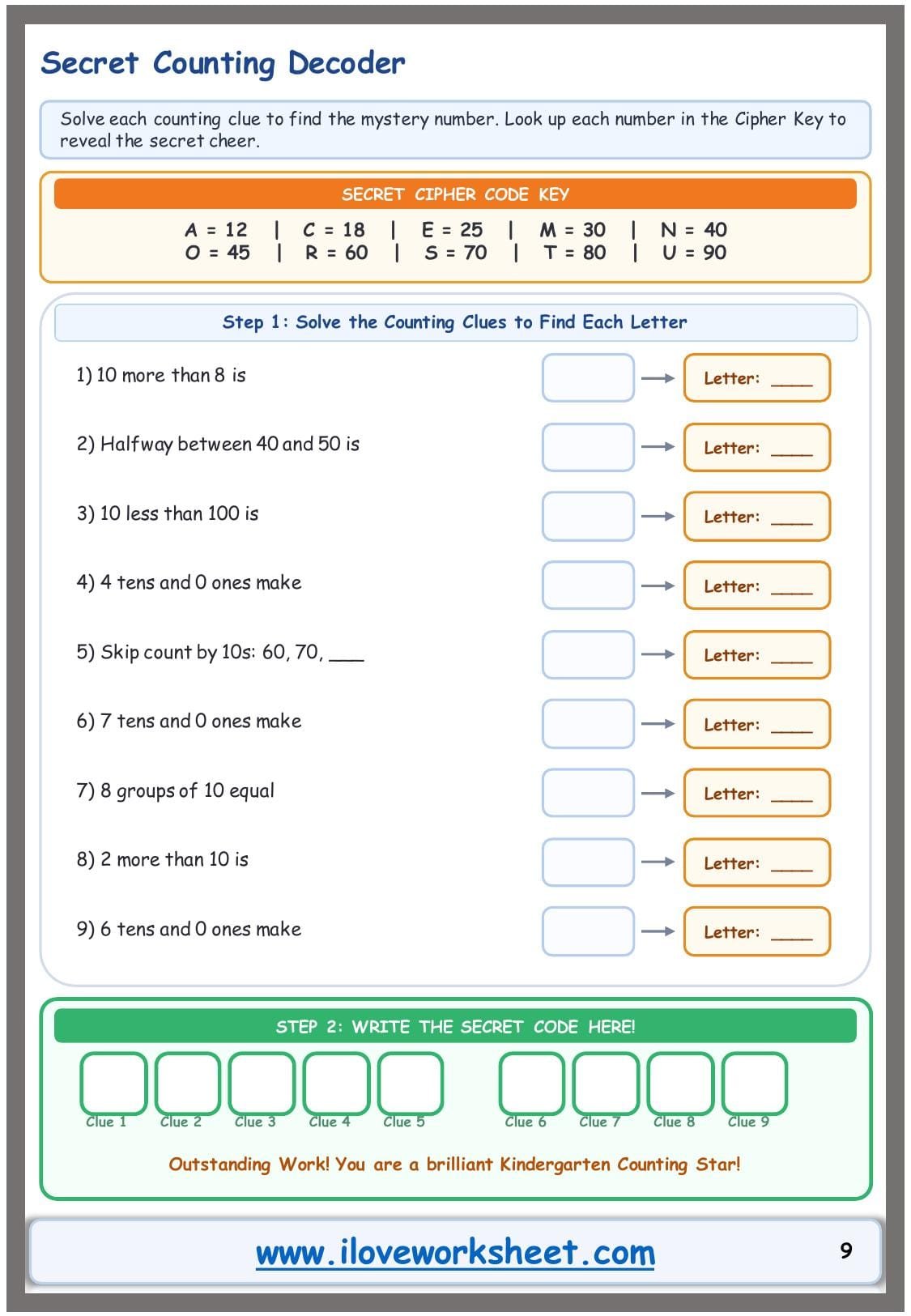
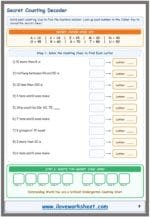
Gamification elements such as secret cipher decoders and mystery number puzzles elevate instructional engagement. When simple counting problems serve as clues to unlock an overarching secret message, children experience heightened motivation and sustained focus.
The cognitive loop of solving mathematical clues, matching numerical results with an alphabetical cipher key, and writing the decoded letters into clean blank mystery tiles integrates mathematics with early literacy and deductive reasoning. This multi-disciplinary reinforcement ensures high student satisfaction, deep concept retention, and joyful discovery.
Double Ten-Frame Models for Subitizing and Base Ten Grouping
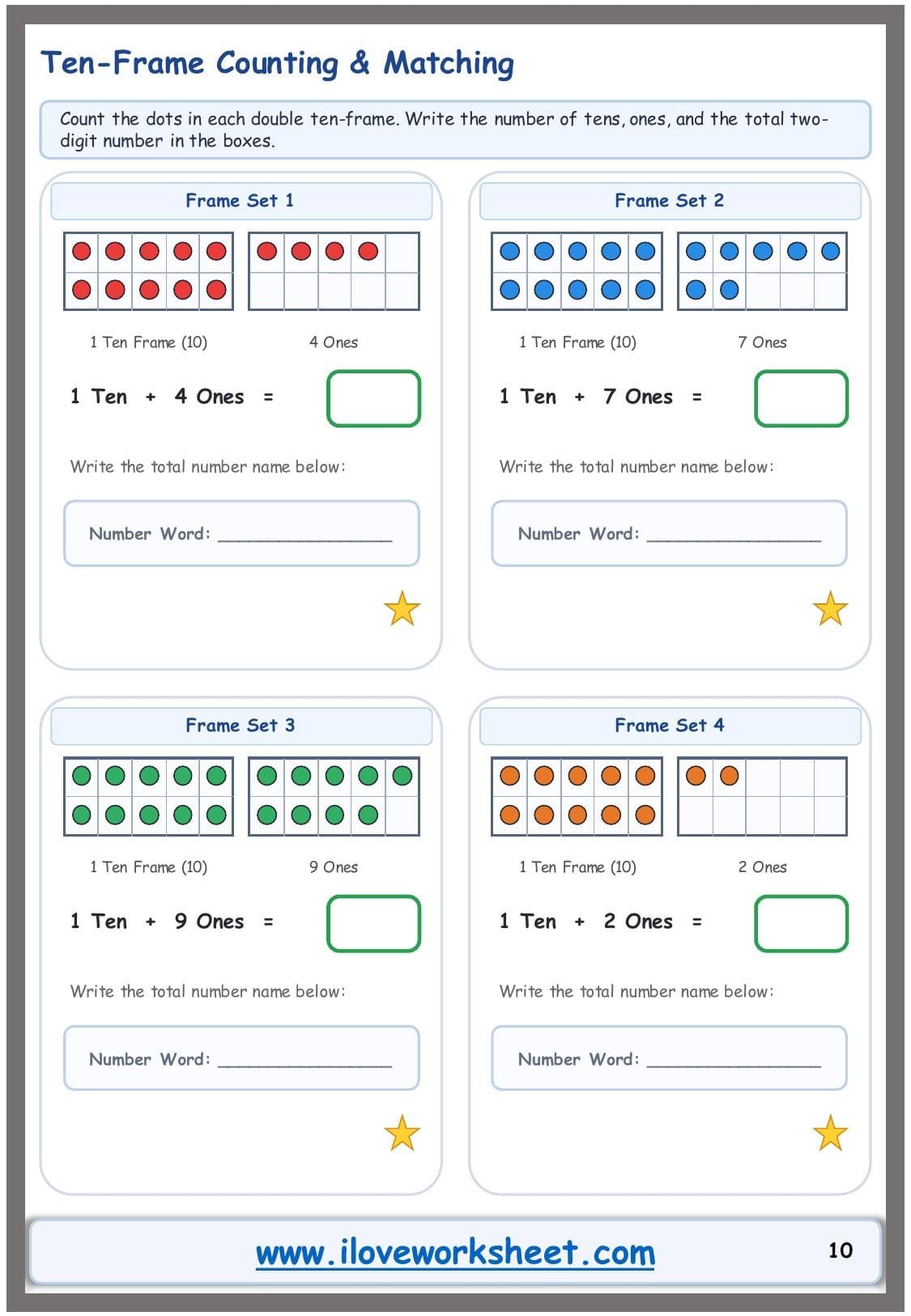
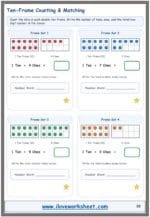
Ten-frames provide a two-by-five rectangular grid that enables rapid perceptual subitizing and structured quantity recognition. When examining numbers between eleven and twenty, double ten-frames instantly highlight the fundamental structure: one complete ten-frame containing ten counters alongside a secondary frame holding loose ones.
Visualizing teen numbers as a completed ten plus additional units prevents common misconceptions where children treat digits as isolated labels. Writing the corresponding decomposition equation directly below the frames reinforces algebraic equivalence and mental calculation strategies.
Part-Part-Whole Relationships with Dominoes and Number Bonds
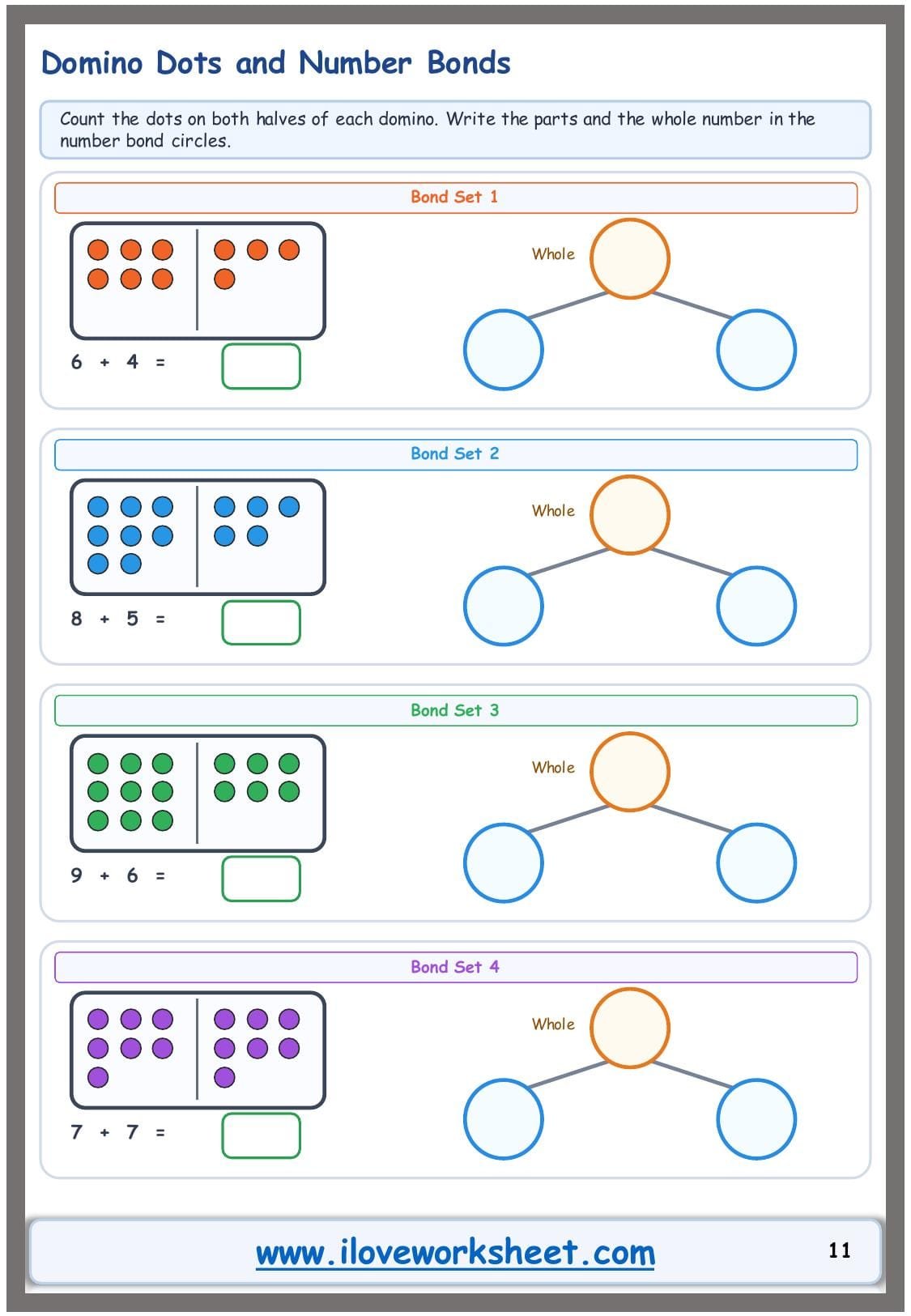
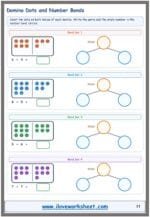
Number bonds represent the foundational architecture of additive and subtractive reasoning. By connecting split domino dots to circular number bond models, young mathematicians visualize how two discrete parts join together to form a unified whole.
This relational model cultivates operational flexibility. Children discover that ten can be composed of six and four, seven and three, or five and five. Developing part-whole fluency early in kindergarten eliminates reliance on finger counting and establishes the cognitive groundwork for mental math facts.
Predecessor and Successor Concepts in Sequential Number Trains
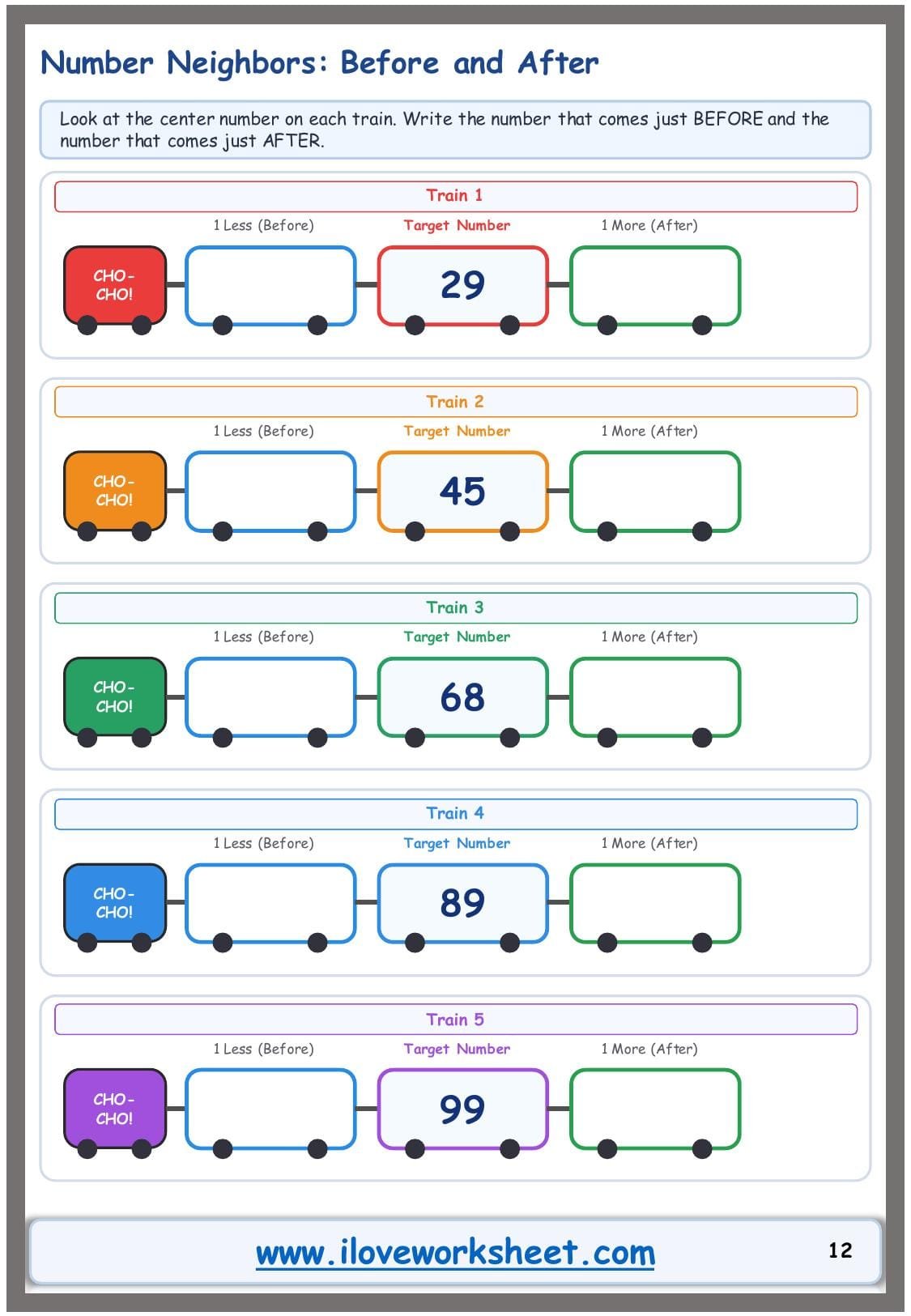
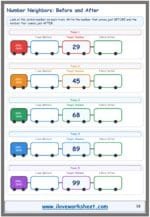
Understanding number neighbors: identifying the exact number that comes immediately before (one less) and immediately after (one more), is critical for developing flexible mental navigation along the mental number line.
Locomotive train cars and segmented sequences offer an intuitive visual context for predecessor and successor reasoning. When presented with central two-digit benchmark numbers such as twenty-nine, forty-five, or ninety-nine, learners practice crossing critical decade boundaries with precision.
Tally Mark Bundling: Rhythmic Grouping and Five-Based Anchors
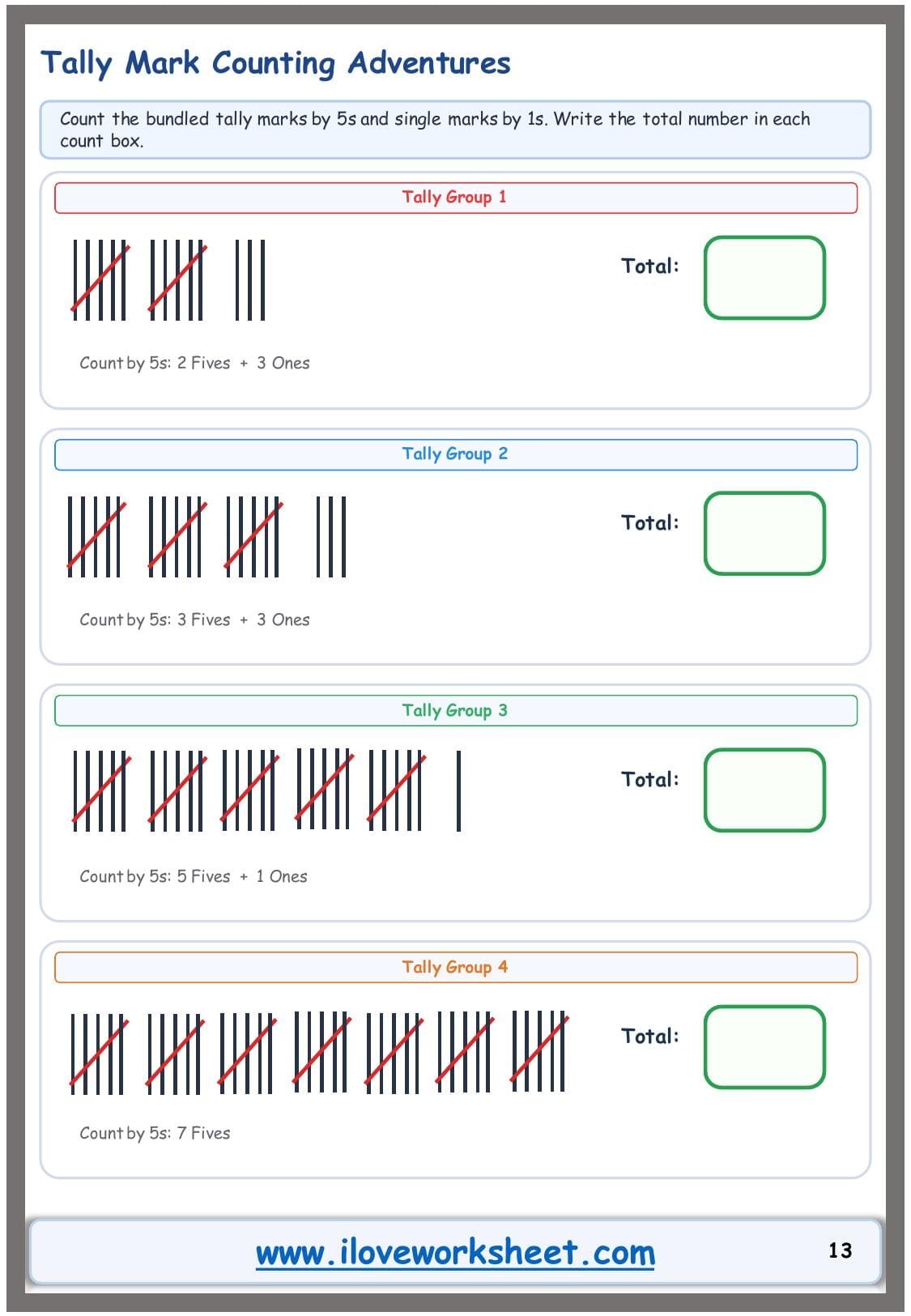
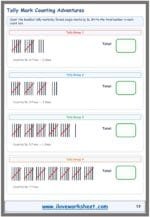
Tally marks introduce children to standardized data collection and grouping methodologies. By creating bundles of four vertical strokes crossed by a diagonal fifth slash, tally charts visually demonstrate groups of five.
Counting bundled tallies reinforces skip counting by fives combined with counting on by single units. This dual-speed counting strategy strengthens cognitive flexibility as children shift seamlessly from rhythmic skip counting (five, ten, fifteen) to sequential unit counting (sixteen, seventeen, eighteen).
Numerical Magnitude Organization: Ascending and Descending Order Pathways
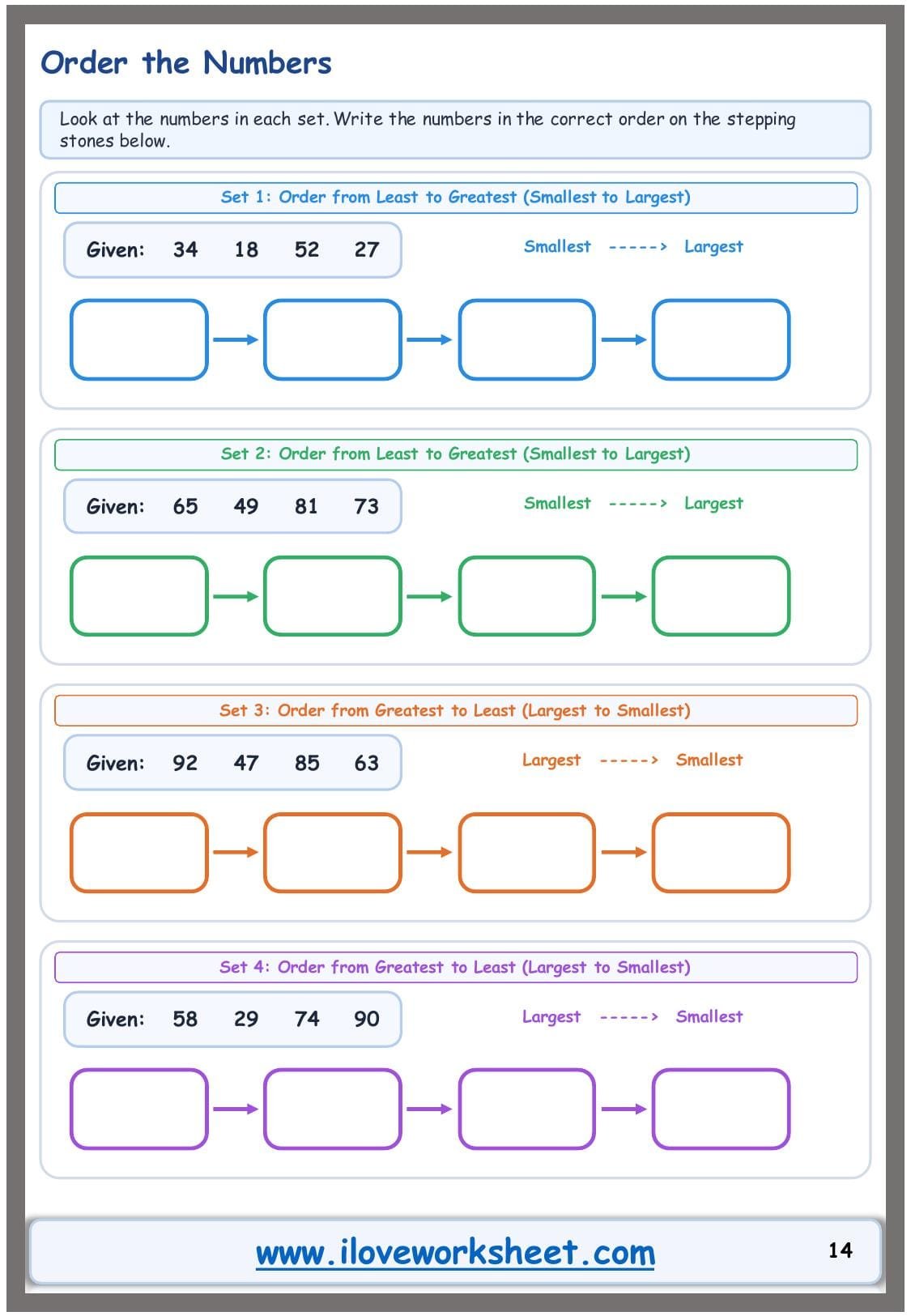
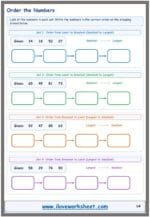
Ordering sets of multi-digit numbers from least to greatest and from greatest to least requires systematic comparative analysis. Learners must examine place value magnitudes, evaluate tens digits first, and resolve ties by inspecting units digits.
Stepping stone pathways with directional flow indicators support children through the ordering process step by step. Mastering numerical sequencing builds the spatial ordination skills essential for data sorting, measurement scales, and coordinate graphing.
Comprehensive Review Through Skip-Counting Labyrinths and Mastery Quests
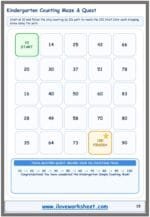
Interactive counting mazes synthesize multiple numeracy skills into an enjoyable culminating quest. Navigating a path from ten to one hundred by tens requires students to discriminate between correct sequential multiples and surrounding distractor numbers.
This selective attention challenge deepens numerical memory while providing immediate intrinsic reward as learners reach the golden trophy finish line. Combining varied visual models, hands-on tracking, and rigorous conceptual frameworks creates a complete kindergarten numeracy foundation.