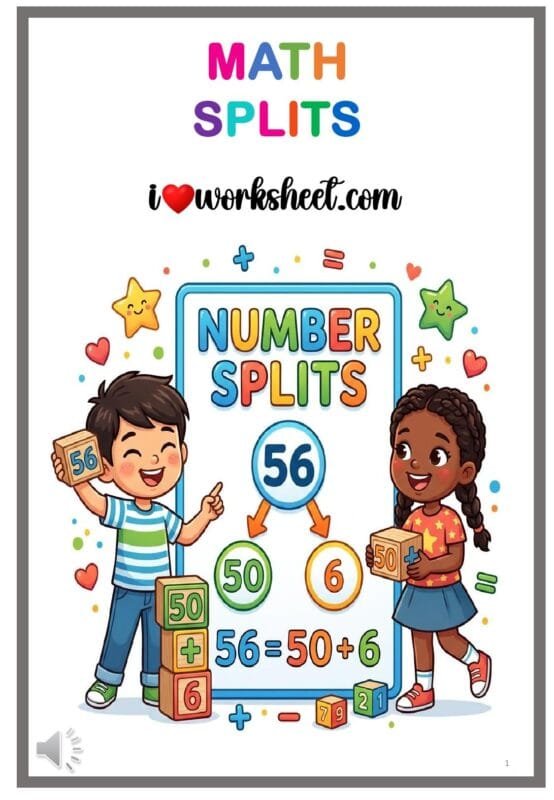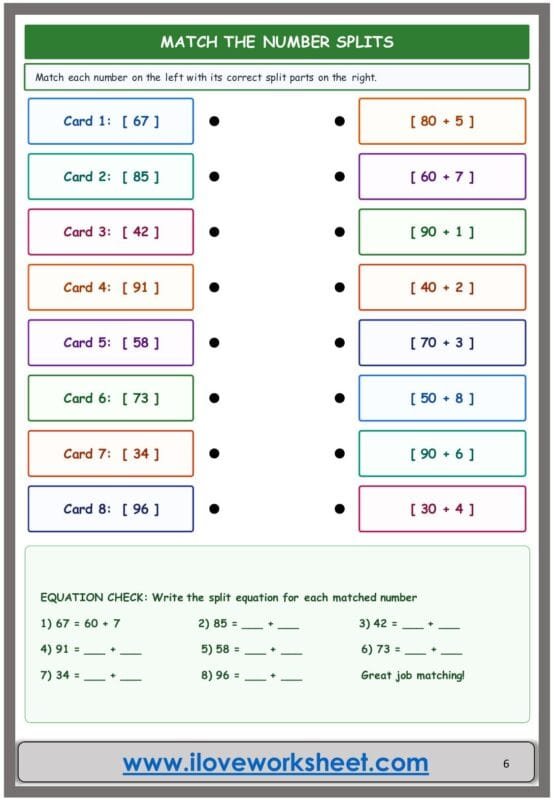





Early childhood mathematics education marks a decisive cognitive milestone as young learners transition from perceptual counting to structured arithmetic reasoning. In elementary classrooms across the United States and the Netherlands, children initially encounter numerical concepts through qualitative observations before mastering formal symbolic abstractions. Developing fluency in number decomposition—the ability to partition a composite whole into distinct subsets—serves as the cornerstone for mental addition, subtraction fluency, proportional reasoning, and early algebraic thinking. When children understand that a total quantity can be split into equal groups or reassembled without changing its fundamental value, they construct the conceptual architecture required for lifelong mathematical achievement.
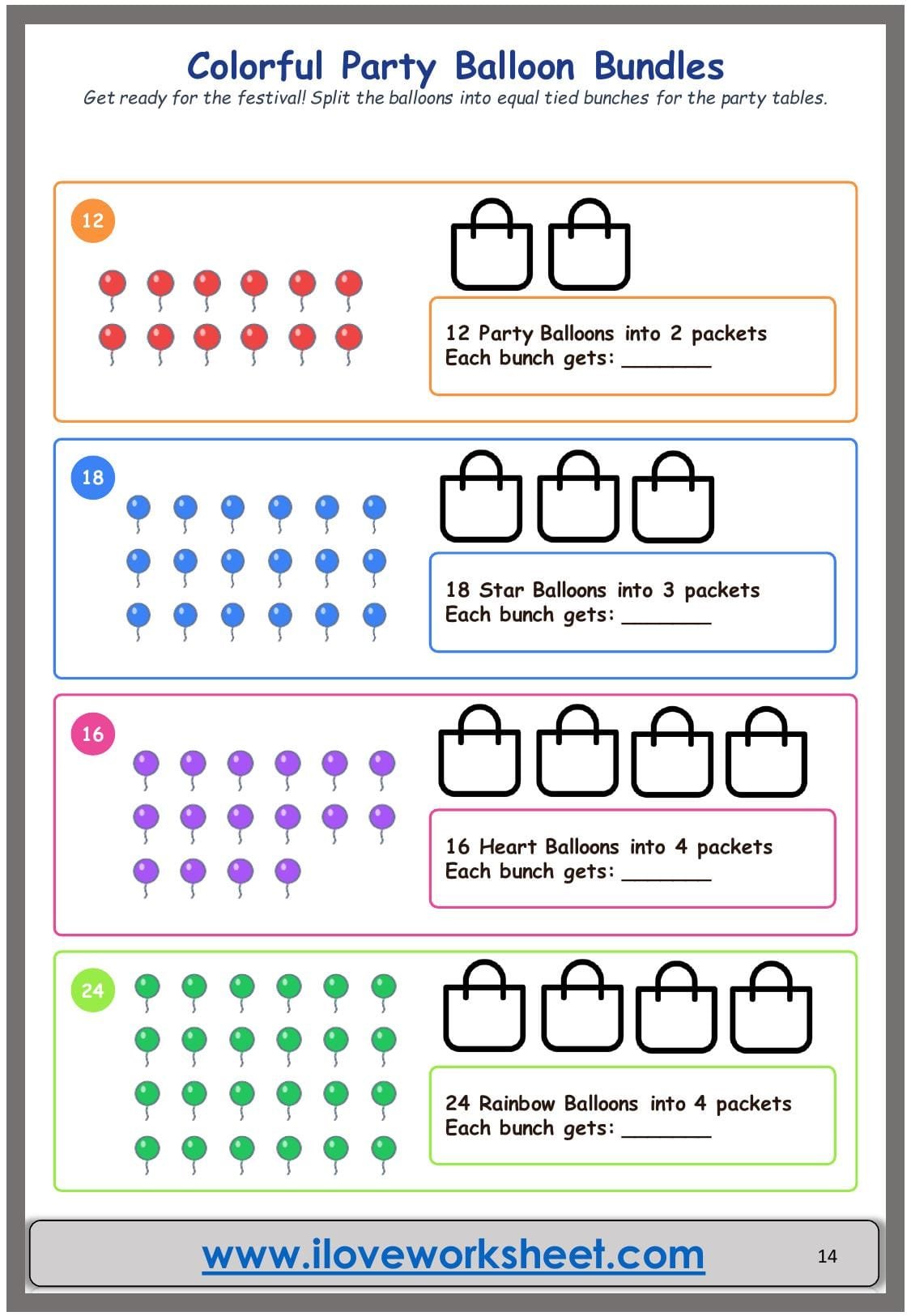
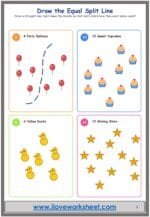
The trajectory of early numeracy commences with perceptual subitizing, where infants and toddlers intuitively perceive small collections of up to three items without counting. As children mature through preschool and kindergarten, perceptual subitizing evolves into conceptual subitizing, enabling students to recognize larger quantities instantly by identifying smaller constituent groups. For example, observing eight festive balloons arranged symmetrically as four on the left and four on the right allows the developing brain to register two equal sets of four rather than engaging in tedious, error-prone linear counting. This rapid visual synthesis anchors the foundational mathematical truth that numbers are composite structures composed of interconnected parts.
Educational policy frameworks reflect this cognitive priority internationally. Within the United States, the Common Core State Standards for Mathematics mandate foundational counting and cardinality in Kindergarten (CCSS.MATH.CONTENT.K.CC), directly establishing operations and algebraic thinking in Grade One and Grade Two (1.OA and 2.OA). Parallel educational objectives define Dutch primary pedagogy under the national curriculum standards articulated by the SLO (Stichting Leerplan Ontwikkeling). In Dutch primary schools (basisscholen), particularly within Groep 2, Groep 3, and Groep 4, mathematical instruction emphasizes Realistic Mathematics Education (RME), an instructional methodology pioneered by the Freudenthal Institute. RME dictates that mathematics must originate from experientially real contexts where children intuitively mathematize recognizable scenarios, making visual splits a natural instructional medium.
Instructional efficacy in elementary mathematics depends significantly upon Jerome Bruner’s seminal hierarchy of cognitive representation, encompassing enactive, iconic, and symbolic phases. Modern educational research formalizes this progression into the Concrete-Representational-Abstract (CRA) instructional model. While concrete manipulatives such as interlocking plastic blocks, wooden counting pegs, and colored tokens provide indispensable tactile input, physical manipulatives alone exhibit practical limitations. Tangible items can easily scatter, roll off desks, or become tactile distractions that divert attention away from the overarching numerical patterns.
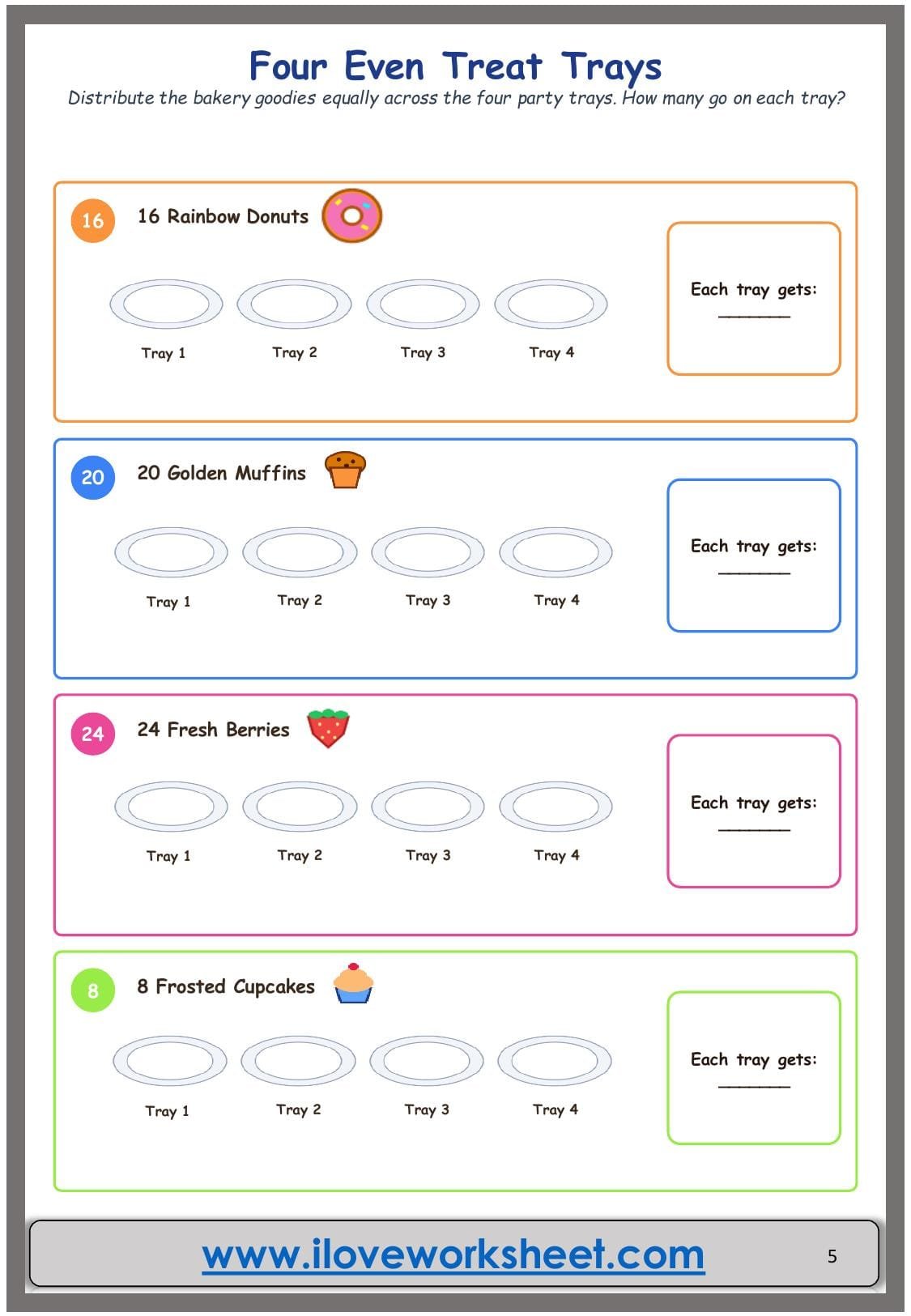
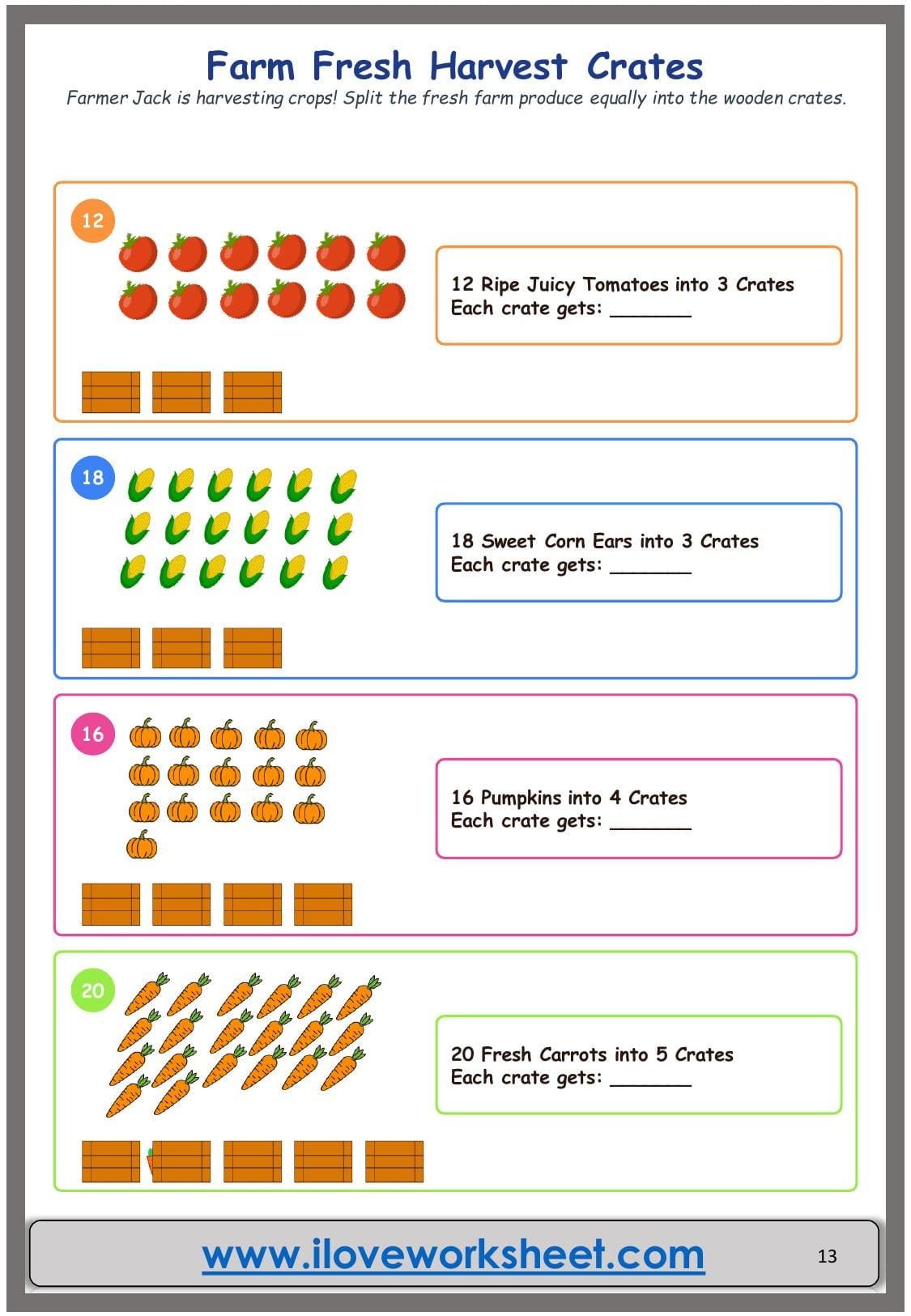
Pictorial models occupy the indispensable representational bridge within the CRA sequence. A visual worksheet depicting sixteen glazed donuts distributed evenly across four serving trays provides a permanent, structured visual anchor. Students can visually track, enumerate, and verify each individual object while simultaneously perceiving the collective arrangement in its entirety. Unlike physical objects that fluctuate in position, pictorial diagrams preserve precise geometric boundaries and structural symmetry. This spatial stability reduces extraneous cognitive load, enabling young minds to allocate working memory resources directly toward numerical relationships.
Furthermore, dual-coding cognitive theory demonstrates that human information processing operates through separate yet interconnected verbal and non-verbal mental channels. By integrating engaging, high-contrast cartoon illustrations—such as cheerful animal companions, bakery items, and playful vehicles—alongside clear numeric labels, educators activate both cognitive streams simultaneously. This dual activation accelerates conceptual encoding, enhances memory consolidation, and transforms routine mathematics practice into an intrinsically delightful educational exploration.
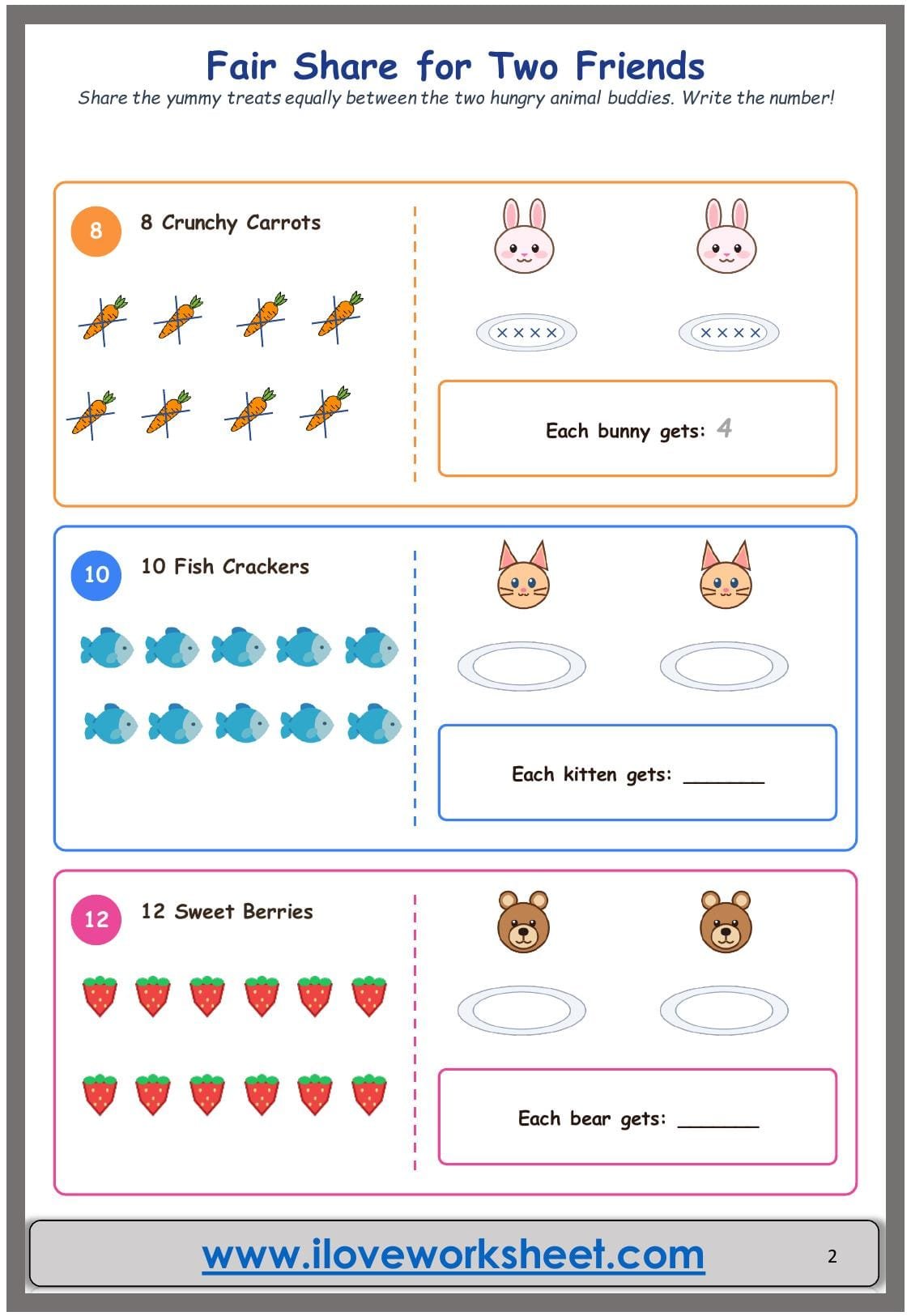
Fair sharing, celebrated in Dutch educational tradition as ‘eerlijk verdelen’, represents one of the most intuitive entry points into mathematical division. Long before stepping into formal classrooms, children demonstrate an acute sensitivity to social distributive justice. When dividing birthday treats, playroom toys, or coloring pencils among peers, children naturally demand strict parity: every participant must receive the exact same portion, ensuring complete fairness without arbitrary bias or remainder.
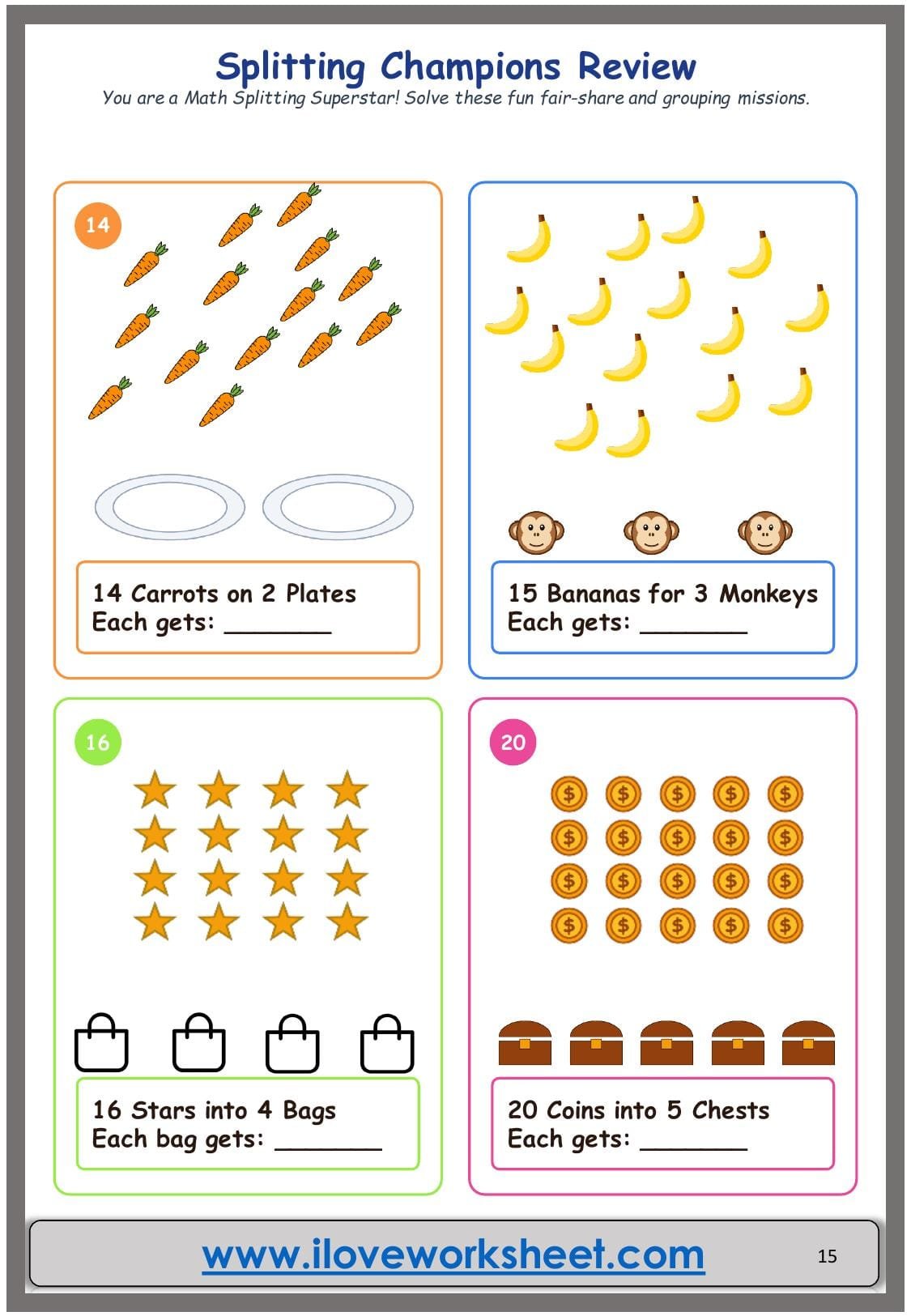
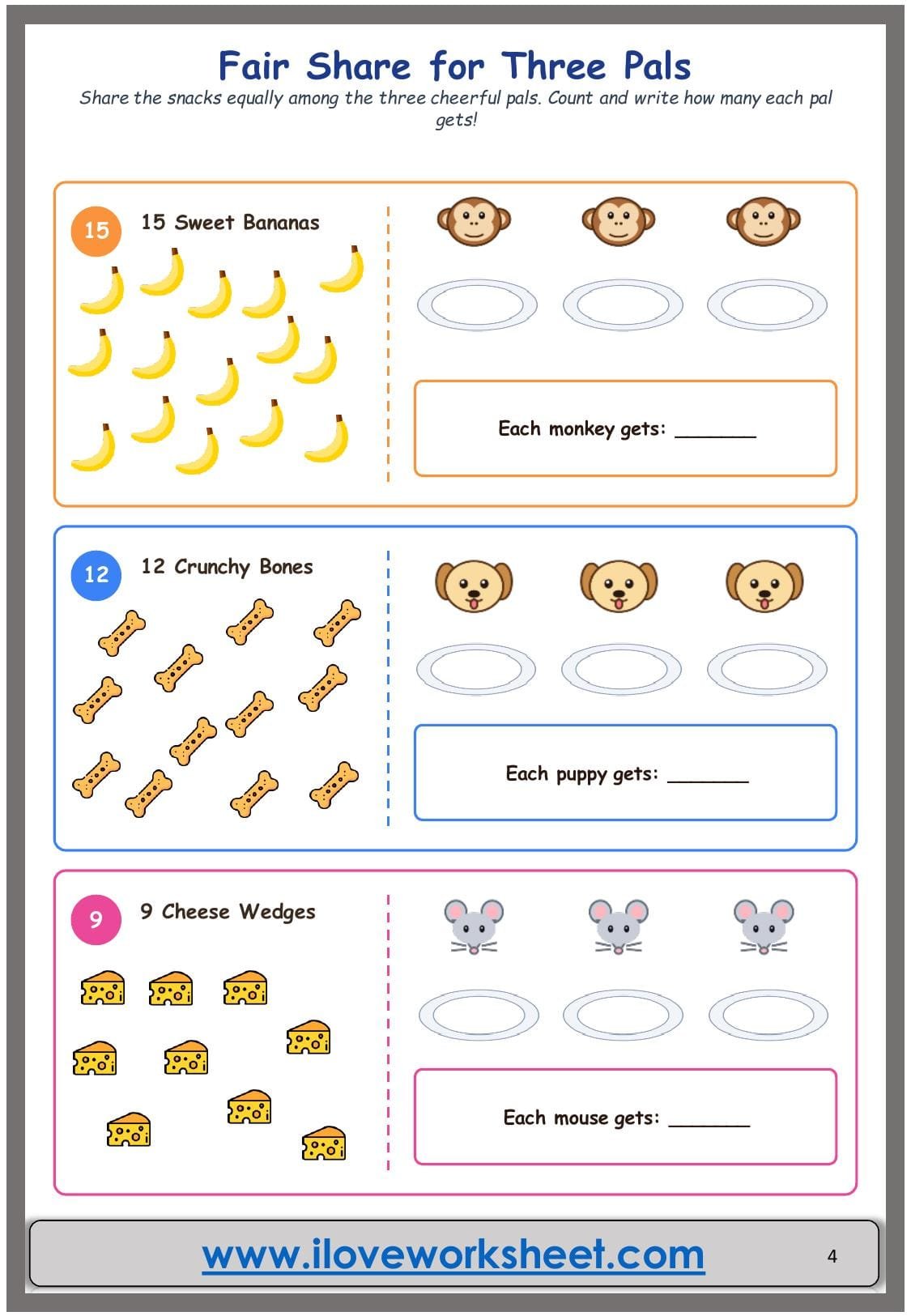
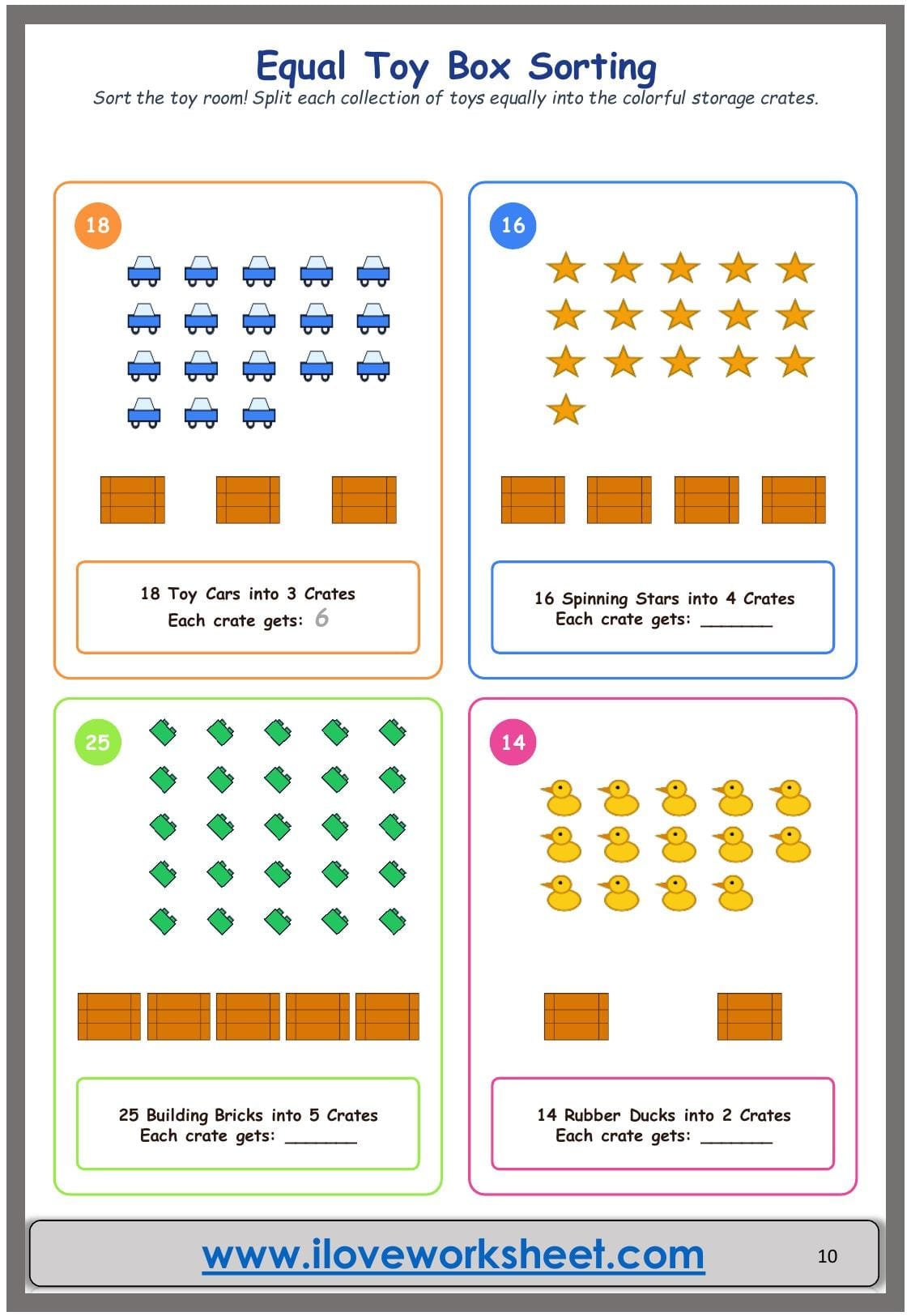
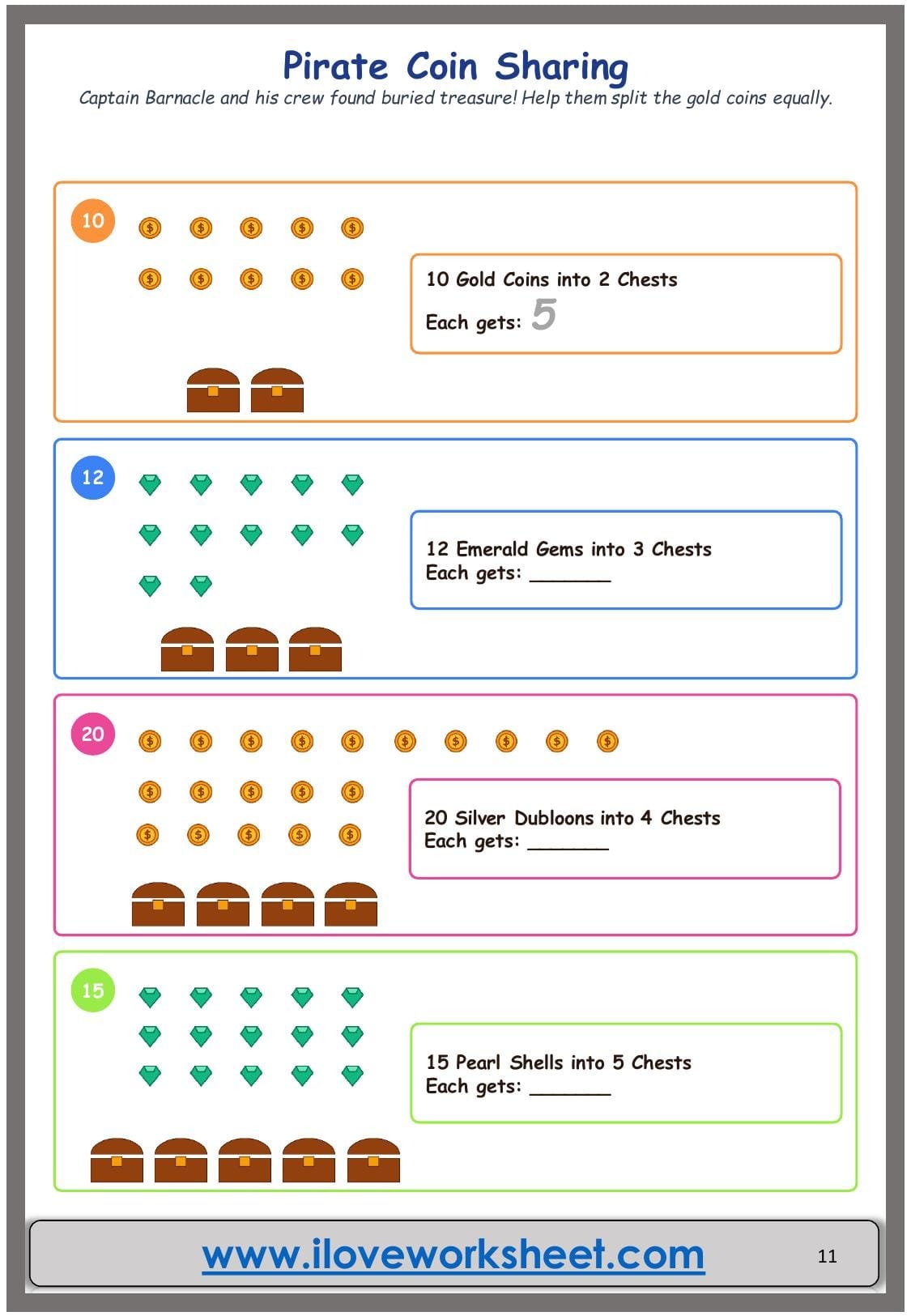
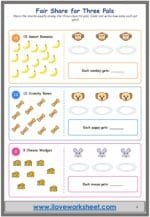
From a mathematical perspective, fair sharing embodies partitive division, wherein the total quantity and the number of recipient groups are predetermined, and the problem requires identifying the resulting size of each equal share. When a worksheet invites students to partition fifteen bananas equally among three friendly monkeys, emerging mathematicians instinctively apply systematic distribution strategies. Novice counters frequently employ a one-to-one dealing strategy, mentally allocating one item to each recipient iteratively until the total supply is depleted.
With structured visual exposure, children rapidly progress from repetitive one-by-one counting toward multiplicative chunking. A student begins to recognize that fifteen split three ways produces shares of five because three groups of five reconstitute the original fifteen. This conceptual bridge links early kindergarten counting directly to fractional thinking, ratio concepts, and formal division algorithms in upper elementary grades. By validating and formalizing children’s intuitive sense of fairness, teachers establish a positive affective relationship with arithmetic, preventing the onset of math anxiety.
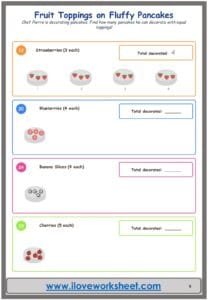
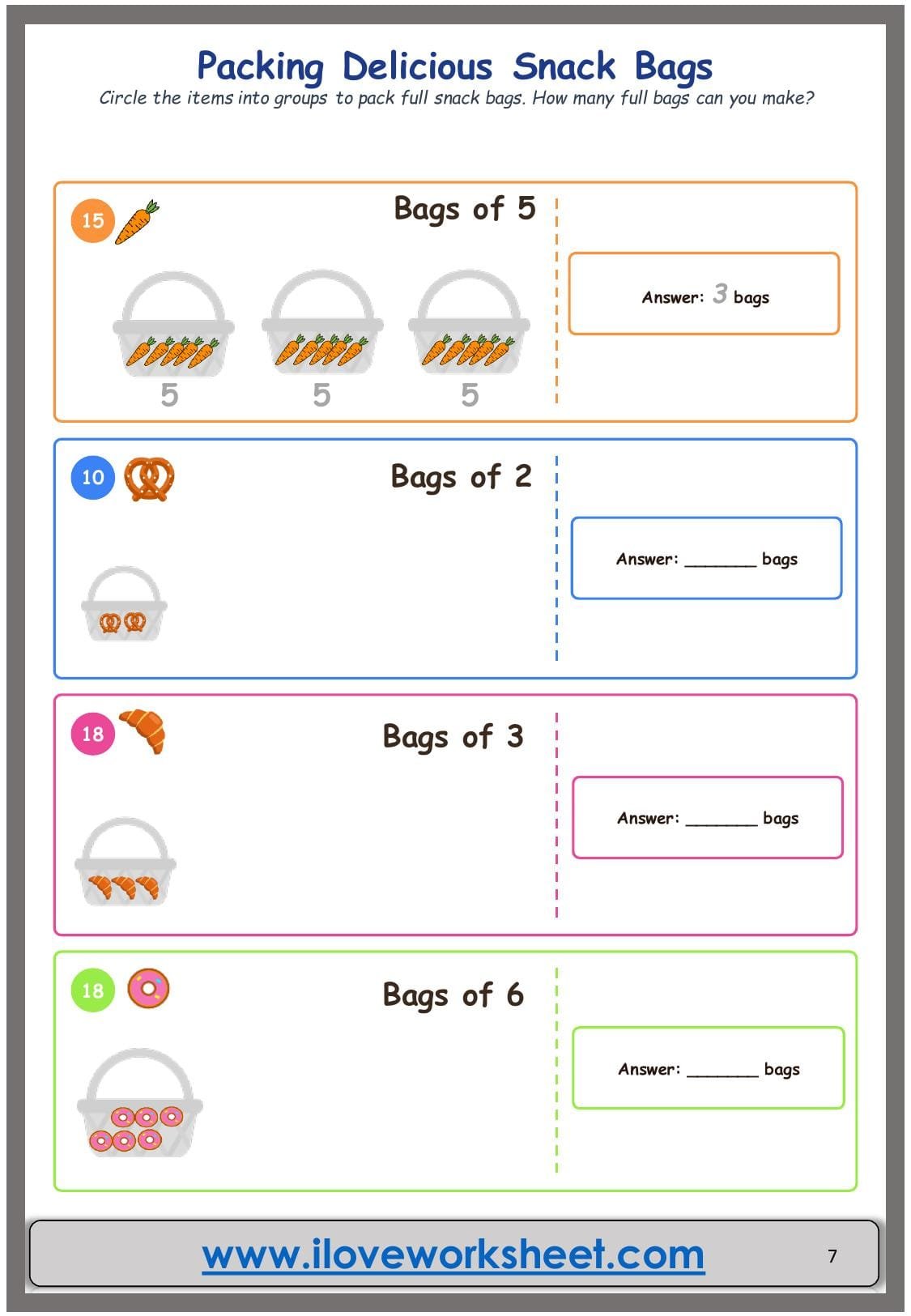
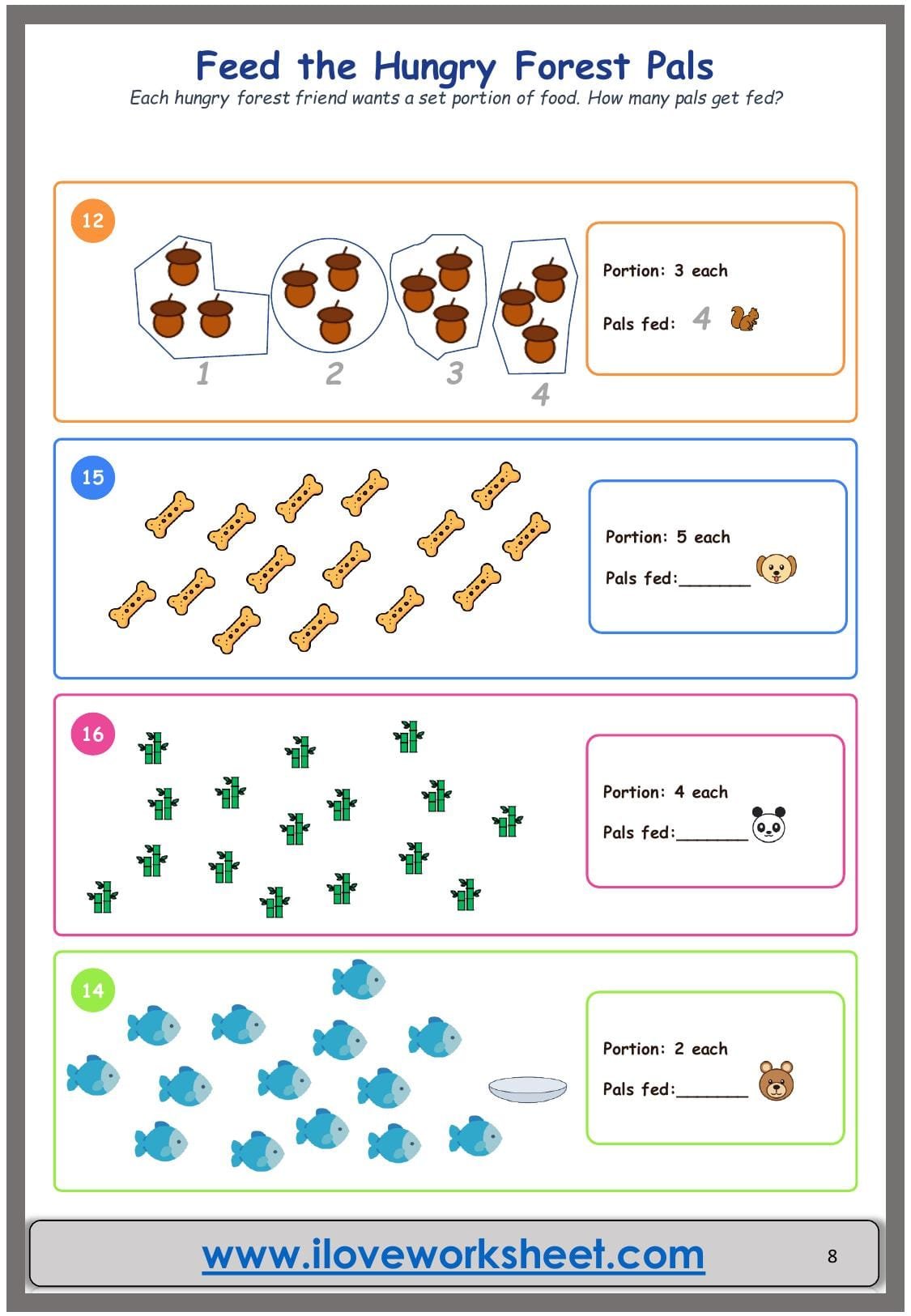
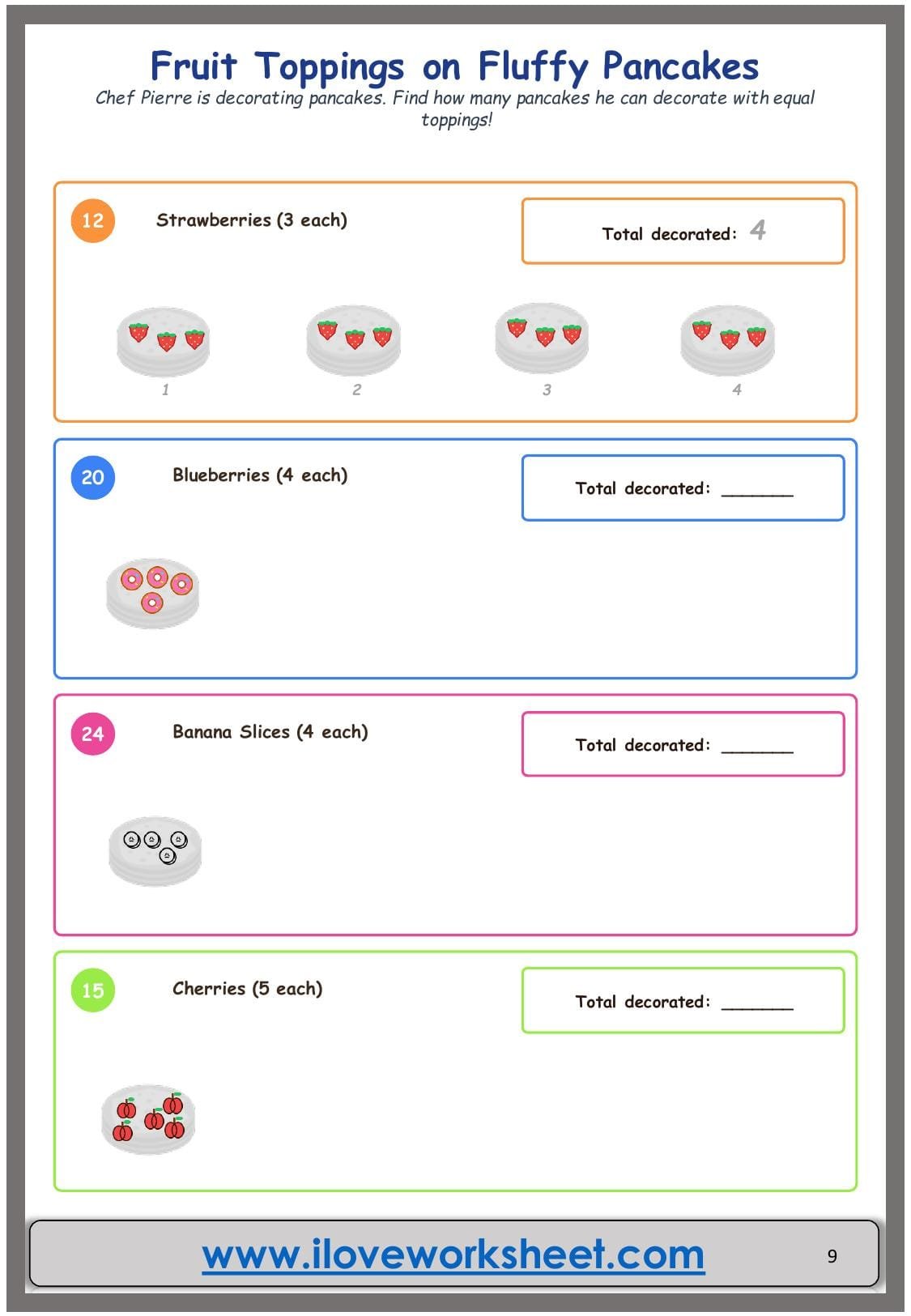
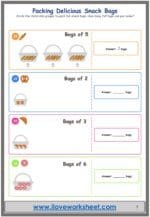
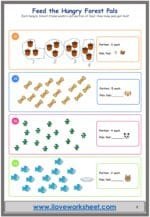
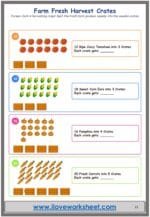
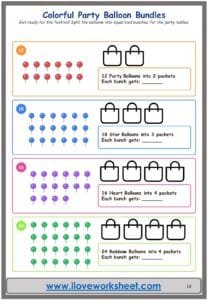
While partitive fair sharing focuses on determining the size of each share, quotative division—frequently designated as measurement division or grouping—requires determining how many equal groups can be formed from a total quantity when the group size is fixed. Problems asking how many paper bags can be packed with baguettes when each bag contains five loaves, or how many forest animals can be fed when each squirrel receives three acorns, exemplify this critical conceptual shift.
Quotative grouping demands the cognitive ability known as unitizing: treating a collection of multiple individual entities as a singular composite unit. When a child circles three dog bones to feed one puppy, that student is coordinating two simultaneous levels of units: three individual physical items and one composite portion. Cognitive scientists identify unitizing as one of the most intellectually demanding transitions in early childhood mathematics. Without mastery of unitizing, children remain trapped in persistent one-by-one counting, struggling to comprehend multi-digit place value, base-ten bundling, and algebraic factoring.
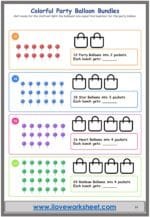
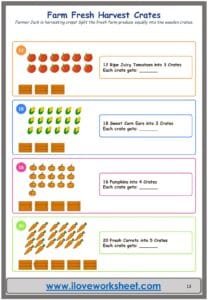
Visual grouping worksheets provide explicit cognitive scaffolding for unitizing. By circling equal clusters of objects on a printed page or observing items already partitioned into distinct crates and baskets, learners clearly witness the conversion of single items into composite groups. The physical act of drawing boundaries or following dashed guidelines reinforces tactile-kinesthetic memory, ensuring that composite units become tangible mental landmarks.
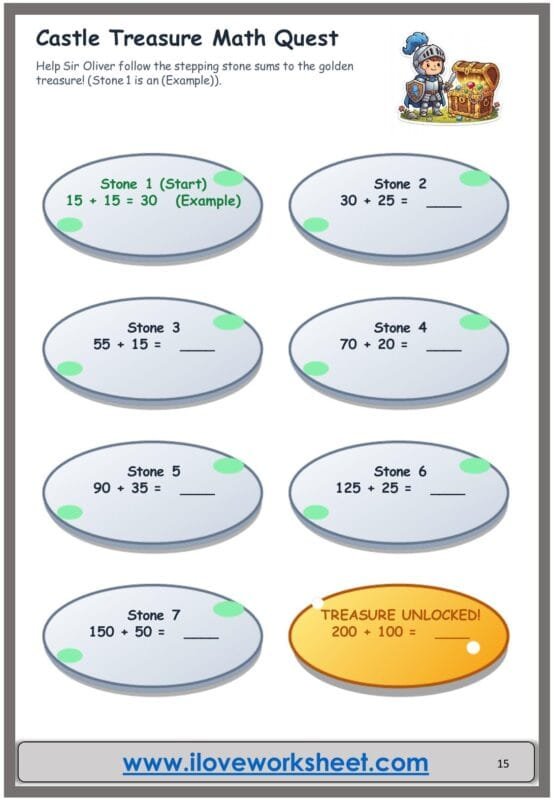
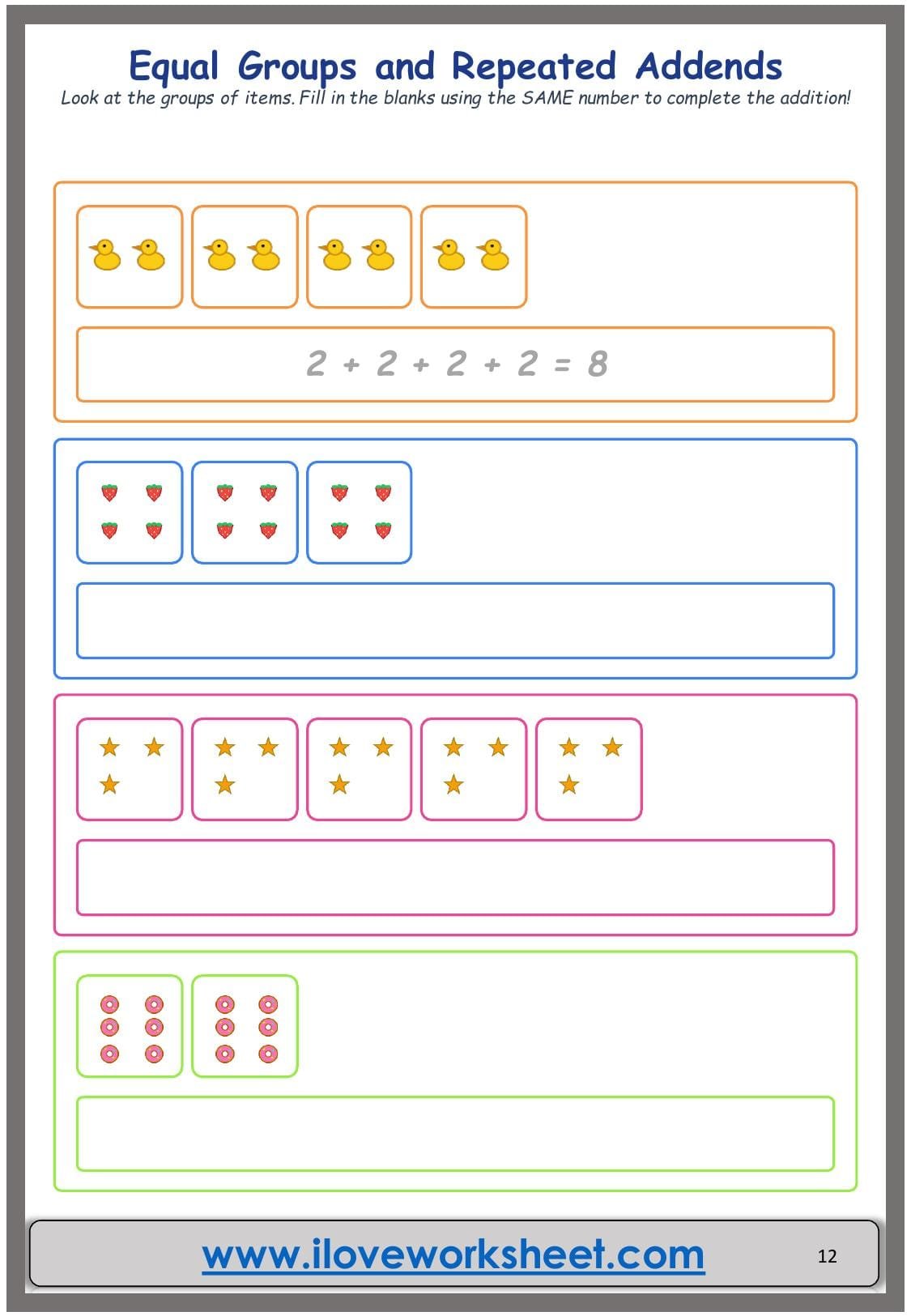
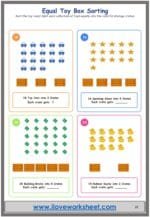
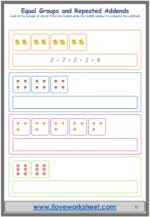
Number decomposition through equal subsets illuminates the vital conceptual bridge between additive structures and multiplicative reasoning. Multiplicative thinking does not emerge as a simple extension of addition; rather, multiplicative reasoning requires coordinating identical addends systematically. When students analyze a visual array of twenty apples arranged across four crates of five, the mathematical relationship can be formulated both additively (5 + 5 + 5 + 5 = 20) and multiplicatively (4 groups of 5 equal 20).
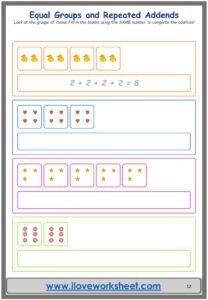
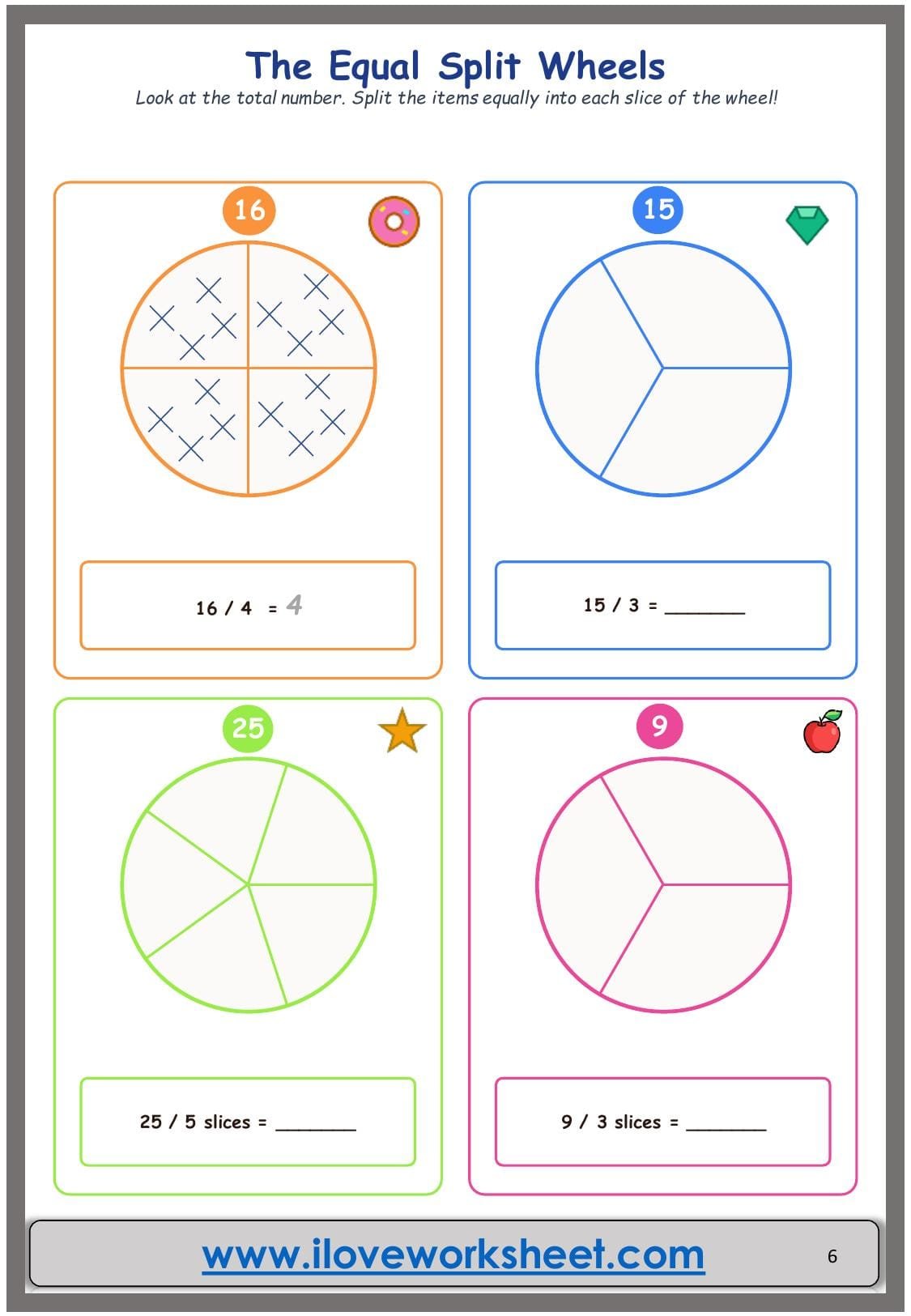
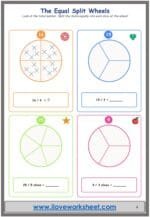
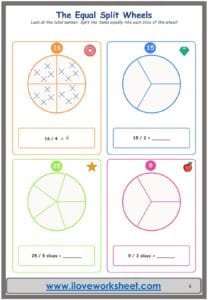
Worksheets that require learners to complete addition sentences using the exact same number reinforce the algebraic principle of equality and numerical balance. Analyzing circular split wheels segmented into thirds, fourths, or fifths provides compelling geometric reinforcement. The split wheel displays the total quantity prominently at its center hub while radiating outward into congruent sectors. This circular architecture introduces children naturally to rotational symmetry, polar coordinate division, and circular fraction models, demonstrating visually that twenty-four can be simultaneously decomposed into four sixes, three eights, or two twelves.
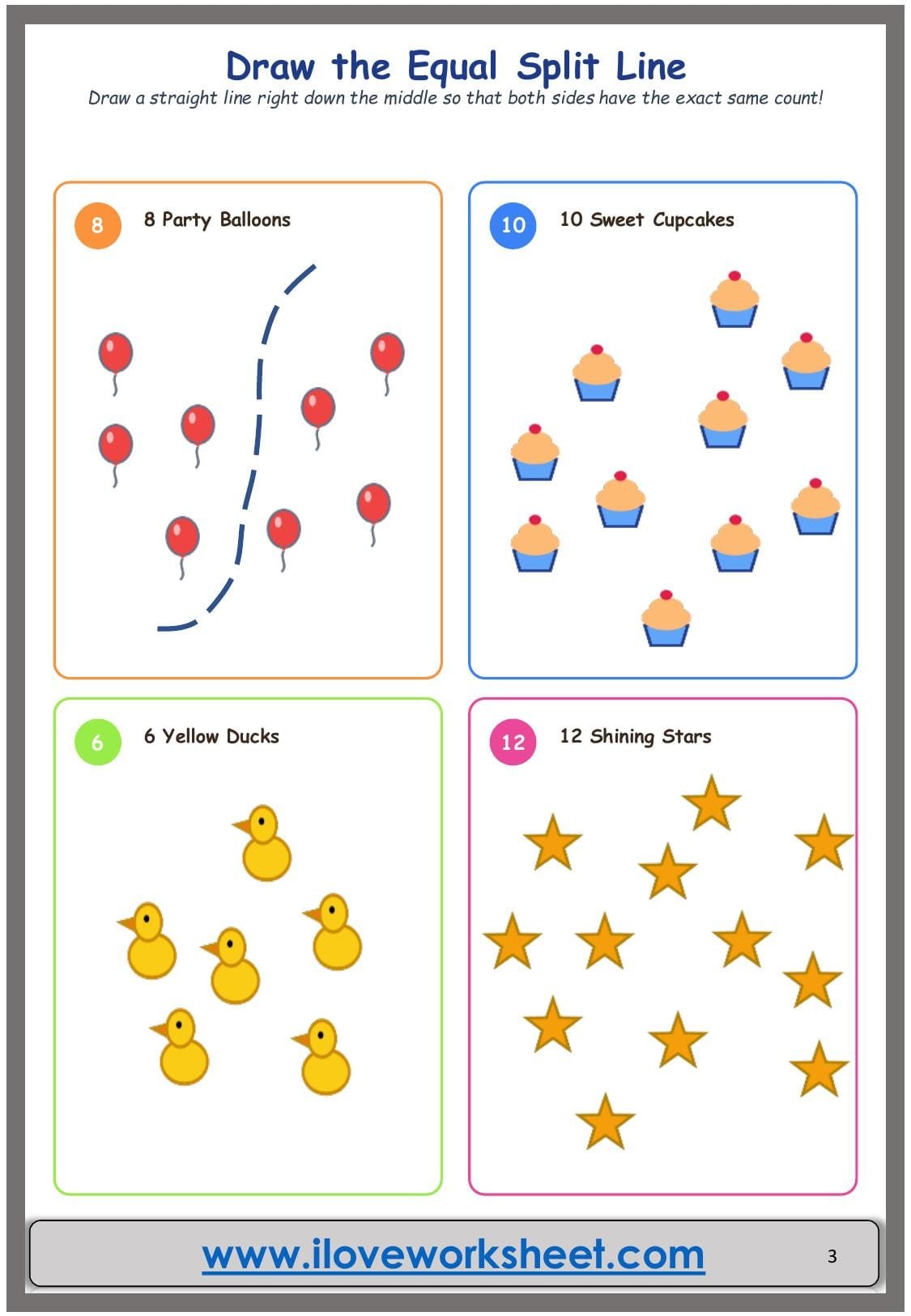
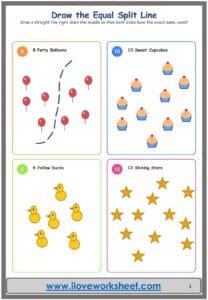
Drawing vertical partition lines down the center of balanced arrays further instills the concept of mathematical parity. Dividing a collection into two identical halves introduces the fundamental concept of even numbers, bilateral symmetry, and reflectional geometry. As young scholars observe that an even number cleanly splits without any leftover remainder, they internalize the definition of divisibility in an intuitive, visual manner that text-heavy arithmetic textbooks cannot duplicate.
Achieving optimal educational outcomes with visual splitting worksheets demands purposeful instructional design within kindergarten, Grade One, and Grade Two classrooms. Highly effective educators in American school districts and European primary academies structure lessons around intentional three-phase instructional cycles: collaborative inquiry, independent synthesis, and reflective mathematical discourse.
Lessons commence most effectively with collaborative whole-group exploration. Displaying a visual worksheet on an interactive classroom whiteboard allows the teacher to prompt meaningful mathematical dialogue before individual pencil work begins. Inquiring ‘How can the treats be shared fairly so that each animal feels appreciated?’ or ‘What patterns do we notice between the number of plates and the number of berries?’ invites children to articulate diverse problem-solving strategies, cultivating mathematical vocabulary and collective reasoning.
During the independent practice phase, the clean aesthetic presentation of worksheets plays a decisive role in sustaining student engagement. Eliminating clutter, high-stakes scoring headers, and confusing technical terminology allows students to focus entirely on the spatial-numerical task. Visual materials with comfortable white space and rounded card containers support neurodiverse students, including children with attention deficits, autism spectrum conditions, or visual processing sensitivities. Clear pictorial cues provide access for multilingual learners and emerging readers, ensuring universal classroom equity.
Differentiation is effortlessly facilitated by varying the numerical magnitude and grouping complexity across the curriculum sequence. Teachers can assign binary half-splits (such as dividing eight or ten items) to support learners who require foundational reinforcement, while providing multi-step quotative grouping tasks (such as packing twenty-four items into bags of six or partitioning prime-adjacent totals) to challenge advanced learners. Furthermore, visual worksheets serve as responsive formative assessment instruments, giving educators immediate diagnostic visibility into whether a student relies on mechanical finger counting, draws grouping lines, or applies mental doubles.
Spatial reasoning and mathematical competence share an intimate developmental relationship throughout elementary education. Longitudinal studies demonstrate that early spatial manipulation skills—such as partitioning shapes, delineating boundaries, and mentally rotating objects—predict later performance in advanced mathematics, engineering, and scientific fields. Visual splitting tasks systematically engage spatial coordination alongside numerical computation, harmonizing both brain hemispheres during early childhood.
When young students participate in visually scaffolded decomposition exercises, emotional barriers to mathematics dissolve. The playful presence of charming cartoon characters—such as cheerful bunnies sharing carrots, busy pandas sorting bamboo, and friendly bears distributing fresh berries—transforms abstract mathematical tasks into joyful narrative explorations. Students perceive themselves not as test subjects completing tedious drills, but as compassionate problem solvers helping animal friends achieve fairness and harmony.
By establishing an enduring cognitive bridge between concrete intuition, visual representation, and symbolic notation, early childhood educators lay the groundwork for sophisticated arithmetic fluency. Grounded in research-backed pedagogical principles, visual number splitting stands as a transformative instructional approach that empowers kindergarten and primary school teachers across the globe to inspire the next generation of confident, creative mathematical thinkers.